

The following is a transcript of a commentary Peter recorded as an introduction to the Department S episode, ‘A Small War of Nerves’, for the Umbrella Entertainment release of the series. Some of you may’ve already heard this, but for those of you who haven’t, I hope you’ll enjoy it.
“Good evening, ladies and gentlemen.
The main attraction of this episode is, of course, Sir Anthony Hopkins.
I thought the story had a good idea, and I discussed it with the director, Leslie Norman. He’s made many successful films at the famous Ealing Studios, such as the recently shown ‘Dunkirk’. he was the father of Barry Norman, who presented that wonderful television series, Film ’90, ’91, ’92, ’99; it lasted 20 years. Now taken over by that very funny and delightful, Jonathan Ross.
What Barry Norman didn’t know was that his dad directed me in my very first screen test, around nineteen-hundred and thirty-seven, or thereabout. It was for the male lead in a film that was to star Jean Simmons. The scene was in her bedroom, and I was this Latin-American kidnapper who’d come in to seduce her. I don’t know if you’ve ever seen or heard yourself on screen – it’s the most horrible experience in the world!
I took my girlfriend at the time with me to see the rushes of this scene for moral support and boy did I need it! What I saw on the screen bore no relation whatsoever to what I thought I was doing to the camera in the studio. The auditorium darkened. On the screen, we got the Clapper Boy hitting his board, and it said: ‘test for Jean Simmons’ as, erm, Lady whoever, and Peter Wyngarde for Antonio.
My hand had now gripped my girlfriend’s hand in a vice. But there was worse to come! It was the noise that came out of that enormous mouth. The line was: “Hello. My name is Antonio”. What came out sounded like: “Hhheeeellllooooo. Mmmyyyyyy nnnnaaaaammmmmmeeee iiissss Aaaaannnnntttttooooonnnnnnnnniiiiooooo!”
I heard a gasp from my girlfriend, which I thought was in reaction to what was on the screen, but it wasn’t. My nails that I’d dug so far into her hand had drawn blood!
When I reminded Leslie Norman of this test, he said he didn’t remember it being that bad: “At least no worse than someone called Anthony Hopkins!”
When I read ‘a Small war of Nerves’, I said we must go for the best. Halliday has to carry the whole of the first and second part of the film, and the last confrontation scene requires an actor – by that I mean a gifted actor, who can find nuances and tempo to make the scene work. But above all, he must have sensitivity so the audience can sympathise with his motive. Without the right actor there was no film! If he had charisma as well, we’d got it made! Everybody agreed when I suggested Tony Hopkins.
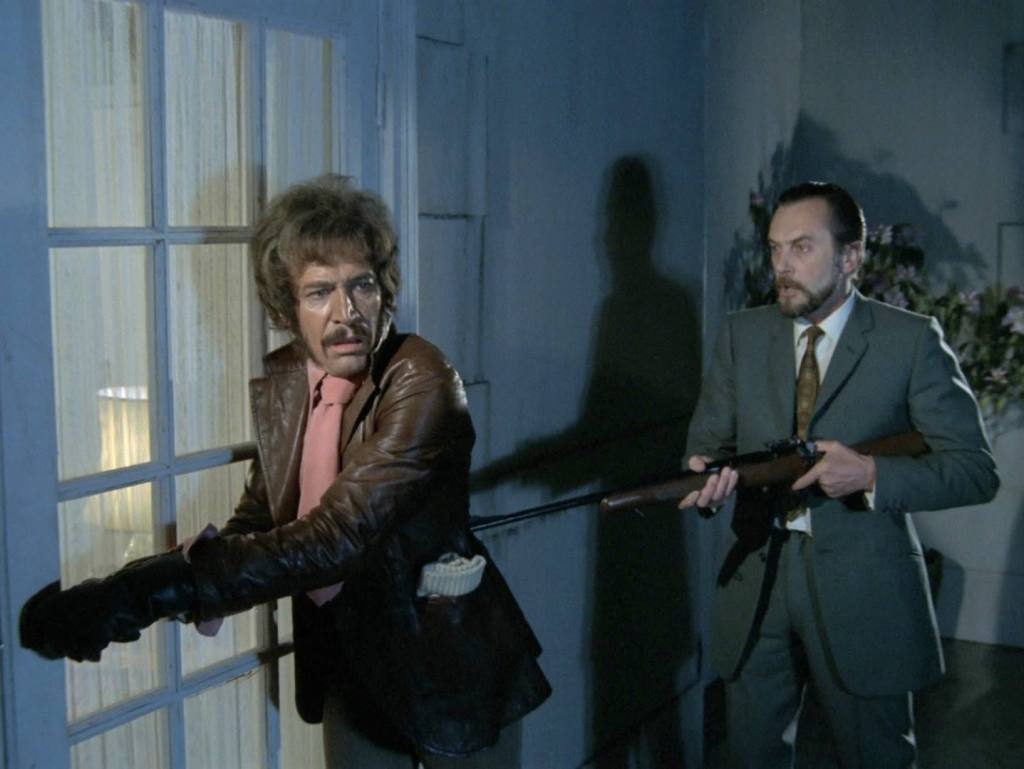
And he’s superb in this as he is in everything he does. He brings a wonderful sincerity, a quirky nervousness, and an enormous power, as always. He makes us believe completely in the character he plays. English actors love to rehearse because of our theatre traditions, I suppose – our training. So at the beginning of the series, I tried to get the cast together just to do this, so as not to waste time with the technicians who were about doing their personal and professional jobs; sort of preliminary search of the best way to get the truth of the script. Or, in some cases, to get more of the truth into it, which the confines of television had robbed. And possibly, actors are the most hardworking profession. It was never difficult to ask them to rehearse – even out of their contractual time… except for Anthony Hopkins!
When he arrived at the studios, I went to his dressing room – first to welcome him, and then to discuss the script and to ask him if there was anything he’d like to lose, or gain – or whatever. It’s called “throwing it around”, and it becomes second nature – spontaneous.
I knocked on his dressing room door. Nothing. I tried again. There was no answer. Again, I tried it. Still no answer. I thought maybe he’s gone to the canteen or something. Then Fredrick Jaeger, who plays the villain – a wonderfully funny man, who kept us all in fits on the set, had the dressing room next door; I was just about to knock on his door to welcome him, when he came out and said: “It’s no good – he won’t answer. We’ve all tried!” We both looked puzzled, and to this day I don’t know why Tony Hopkins didn’t respond to our knock.
So, the big scene at the end of the film was never rehearsed; it is completely spontaneous., and I think all the better for it. Tony taught me that, for films, the whole point is getting ‘The Moment’ – the French call it ‘mystere’d moment’. I call it good acting!
However, we did find, or notice at least, a small empty half-bottle of Scotch a little way down the corridor. I’m sure Tony won’t mind me mentioning this, because he himself has said that, at the time, he was inclined to have a sniff or two.
He’s superb in this, as he is in everything he’s done. he brings a wonderful simplicity; a quirky nervousness, and an enormous power, as always. It makes u believe completely in the character he plays.
Unlike a feature film, we don’t have time to use the details of the finer brushstrokes, because of the very nature of the time set of commercial television. Our guides are the breaks, and points have to be made within them. It’s like a clever puzzle, which has a teaser at the beginning; a fast action pace in the middle, and a swift denoument at the end. To get some red-blooded acting in is a wonderful bonus. And that’s what Tony and the rest of the cast bring to ‘A Small War of Nerves’. “

 PETER WYNGARDE: The Official Website
One thought on “TRANSCRIPT: Peter Wyngarde on Department S”