


Broadcast: Sunday, 5th January 1950
Character: Charles Granillo
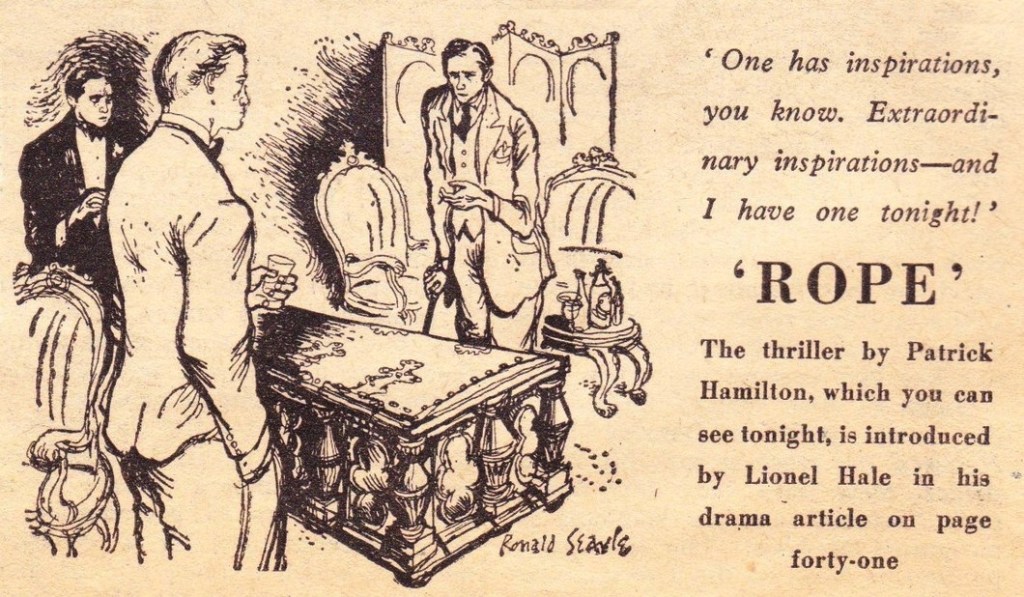
The first edition of the Radio Times in 1950 advised “People with weak nerves” to find something “soothing” to do such as play dominos or draughts when the BBC broadcast Stephen Harrison’s production of Rope, as it might be too much for them. may be too much for them.
Patrick Hamilton’s Rope concerns upper class Oxford student Wyndham Brandon (David Markham) who, under the malign influence of German philosopher, Fredrich Nietzsche and his philosophy of the Ubermensch – the superior man, persuades his weak-minded friend, Charles Granillo (Peter Wyngarde), to help him in the murder a fellow undergraduate, Ronald Raglan, simply for the fun of it.
The pair then place the body in a wooden chest, and to add spice to their crime, invite some carefully chosen acquaintances – including the Raglan’s father, Kenneth (Floyd Allen) – to a dinner party, using the chest as the table from which the food is served.
The theme of the play was suggested by a classic American murder case, in which two young men killed a friend solely for the pleasure of killing him. No motive, surely, could be more appalling.
Brandon: “I have committed murder. I have committed passionless motiveless faultless and clueless murder. Bloodless and noiseless murder.”
Granillo. “Yes.”
Brandon: “An Immaculate murder. I have killed. I have killed for the sake of killing. I am alive. Truly and wonderfully alive.”
Brandon’s first topic of conversation at the party is, of course, murder and, inevitably, the death penalty. Since the play is the perfect whodunit in reverse, as it has the distinction of revealing the murderers from the outset; the thrill of it is to see whether his two undergraduates will get away with it… or end up on the end of a rope.
The man who, in the end, defeats the murderers is poet, Rupert Cadell (Alan Wheatley), who finds the first world war has not made him quite the amoral cynic he thought he’d become. He spots the one mistake that Brandon and Granillo have made. With what appears to be his singular insight into Brandon’s perverted character, Cadell points out that even a seemingly motiveless murder is bound to be found to be solved.
“Because, dear Brandon, that sort of murder would not be a motiveless murder at all. It would ever quietly emotive. Vanity! It will be a murder of vanity. And because of that, the criminal would be quite unable to keep from talking about it or showing it off in some fantastic way or another”.
Hamilton creates tension not with an Agatha Christie-style guessing game, but with the fear of imminent exposure. As with many plays of the era, Rope values neatly constructed plot over character development. It delighted momentarily, but had little further resonance.
Patrick Hamilton always denied that the famous case involving Nathan Leopold and Richard Loeb case in the United States in 1924 in which two teenagers from prominent Chicago families committed an apparently motiveless murder of a 14-year-old boy, was the inspiration for Rope. The similarities between his play, and the Leopold and Loeb crime, make his claim lack credibility.
At the time, this was the 2nd television production of the play.

 PETER WYNGARDE: The Official Website