

Broadcast: BBC Home Service – Friday, 30th August, 1957
Character: Sir Willoughby Patterne
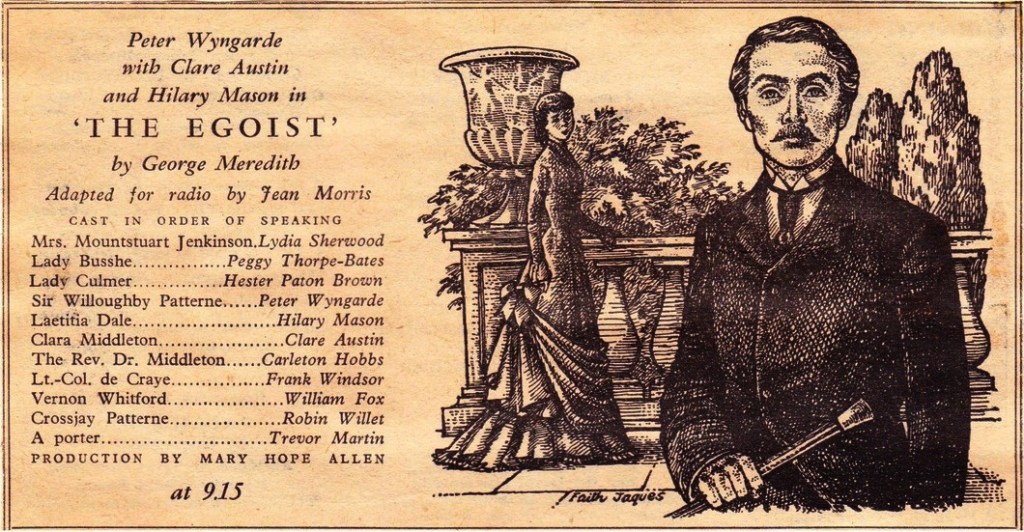
The Story
This “comedy in narrative” begins with the engagement of Sir Willoughby Patterne – “The Egoist” of the title (Peter Wyngarde) to one Constantia Durham. Constantia manages to escape such a fate, however, running away with one Captain Oxford. In order to keep up appearances, Sir Willoughby soon seems to be courting Laetitia Dale, who has been a long time devotee of his. The town quickly supports Sir Willoughby’s egoistic need to be in control of his situation by singing the praises Laetitia.
The months pass by, and soon Sir Willoughby takes a trip to see the world. Upon his return, it is revealed soon that he is no longer interested in Laetitia; the town gossips speculate that Sir Willoughby will meet with Mr. Dale in order to propose marriage of his daughter, but instead, he speaks to him only of renewing his lease of a cottage on his grounds. Meanwhile, Sir Willoughby goes to London, and brings back his cousin, Vernon Whitford, to serve as his secretary at Patterne Hall. A literary scholar, Whitford had very little money of his own, and so was forced to accept money from his rich Baronet cousin. At Patterne, Whiteford devotes his time to walking at times with Laetitia, and also with educating Crossjay Patterne, a young boy who is a relative of Sir Willoughby’s living at Dale cottage. Whitford discerned that Crossjay’s talents suited him for the navy, but the fees for such training were beyond his own resources. Sir Willoughby would spare no such expense either, for he wished Crossjay would be made into a gentleman.
‘Willoughby Patterne is a subtle yet larger-than-life image of egotism, possessiveness, and self-deception; the play narrates how he is at last broken down by the women on whom he plays.’
Soon, Sir Willoughby makes the fateful acquaintance of the beautiful, young Clara Middleton (Clare Austin). Sir Willoughby successfully woos Clara, and she is dazed into accepting an engagement. She protests, however, that she would like some time to see the world before marrying, but Sir Willoughby refuses. Hardly ever listening to Clara, Sir Willoughby talks to her about how they are above “the world” together, and seeks to win her into his egoistic orbit and subordinate all of her desires so that they accord with his. Clara protests that she would like to love “the world” and serve it so that it might be better, but Sir Willoughby discards such notions as naive and childish. He tries to exact an oath from Clara that she will be committed to him even if he should die, but Clara manages to refuse granting such an oath. It is clear that things are not going to be going as Sir Willoughby might wish them to go.
Meanwhile, Sir Willoughby has managed to secure the confidence of Clara’s scholarly father, the Reverend Dr. Middleton. Dr. Middleton is every inch the well-meaning but out-of-touch scholar who speaks in jargon-filled phrases. Unfortunately, he has very traditional patriarchal ideas and does not listen to his daughter’s pleas for traveling before marriage. Dr. Middleton becomes quite settled in, relishing the company of Vernon Whitford, and also Sir Willoughby’s collection of expensive wines.
Thus, Clara’s only comfort comes to be Crossjay, who, in love and in awe of her, seeks only to do her bidding and to make her happy (even when she leaves him under a tree and it begins raining, he does not budge because she has told him to stay). Things with Clara and Sir Willoughby take a turn for the worse when he refuses her counsel on Crossjay as suited for the navy.
When Clara makes the acquaintance of Laetitia Dale, Clara realizes that the devoted Laetitia would be a better match for the egoistic Sir Willoughby. Eventually, Clara goes to Sir Willoughby to apprise him of this and to petition for her own freedom, but Sir Willoughby sloughs off Clara’s words as merely an instance of her jealousy of Laetitia. Try as she might, Sir Willoughby refuses to countenance that she might actually want to be free of him. Much to Clara’s dismay, Sir Willoughby contracts a plan to marry Laetitia to Vernon Whitford so that he might relieve Clara of her supposed jealousy. Clara is supposed to apprise Vernon of this plan, but instead of doing so, she tells him about her predicament and wish for freedom. Vernon is not particularly responsive or encouraging of her freedom, and Clara becomes more and more distressed. Clara also unburdens herself to Laetitia (not to much avail, though Laetitia seems to begin to have an inkling of Sir Willoughby’s egoism, feeling the “power” of Clara’s speech against him).
At this point, Sir Willoughby’s dashing friend, the Colonel de Craye comes to town in order to serve as best man in his wedding. When he comes to town driven in by the slightly drunk Flitch, the carriage is accidentally upset as Flitch swerves to avoid Clara on one of her walks. The porcelain vase which the colonel has brought as a wedding present is broken in this accident (the infamous Mrs. Mountstuart who is gifted at capturing people’s characters in single phrases had once called Clara “a rogue in porcelain”; thus this incident signals that things do not bode well for Sir Willoughby). Indeed, the colonel walks the rest of the way to Patterne with Clara, and the two seem to strike up a friendly relationship. Furthermore, the colonel quickly perceives that all is not well with Clara and Sir Willoughby. Sir Willoughby, hit by suspicions of the colonel, imagines that perhaps Clara has not only spoken to Laetitia and Whitford of her dissatisfactions with him, but also with the colonel.
Unable to take her captivity any longer, Clara contrives to run away, first writing to her bridesmaid and friend Lucy Darleton to secure a place to stay in London. She tells her father that she merely needs a vacation, and at first, Clara manages to convince him to assent to it and also to talk to Sir Willoughby on her behalf. Unfortunately, Sir Willoughby manages to waylay the susceptible Dr. Middleton with expensive wine, and Clara’s plans to leave with her father’s blessing and companionship are foiled. Clara decides to run away anyways, and sneaks out to the railway station with Crossjay as a guide. A rainstorm follows, and soon the men of the house go off to try to find her. Whitford is the first to find her, and he does not force her to come home, but instead gives her some medicine to prevent her catching cold and then counsels her to think also on the cost of leaving behind her father and Crossjay. Clara is nettled, but still thinks to go through with her plan. Vernon consents, and even helps her out by distracting Mrs. Mountstuart, who was also at the station, meeting one Professor Crooklyn who will attend a dinner party of hers. It happens that the colonel also goes to the station, having guessed that Clara might be there. At the last minute, Clara decides to ride back to Patterne Hall with the colonel.
Though De Craye helps to cover for Clara, Sir Willoughby manages to find out from Professor Crooklyn that Clara had drank brandy with a certain gentleman at an inn. Sir Willoughby jumps to the conclusion that Clara was in love with De Craye, and that the two were plotting to run away together. Clara continues to ask Sir Willoughby for her freedom, but he continues to refuse. At long last, he is worn down and starts to convince himself that perhaps he should prefer Laetitia over Clara. After some mulling over this new thought, Sir Willoughby consults Laetitia on the matter at midnight one night and she refuses him, much to his surprise. Crossjay, who has been banished from Patterne because of his aiding Clara in her escape happened to have snuck back in that night and listened to the conversation between Sir Willoughby and Laetitia.
Crossjay’s loyalty to Clara leads to his scheming to tell Vernon of what has happened. De Craye, however, gets to Crossjay first and manages to guess what he has to tell. De Craye lets Clara know, and she now has ammunition against Sir Willoughby when he once again tries to convince her to marry him. In front of her father, Clara tries to get Sir Willoughby to admit that he has proposed to Laetitia. Pushed into a corner, Sir Willoughby eventually has to give up his game. Because he (mistakenly) believes De Craye to be the “other man,” Sir Willoughby tells Clara that she may be free only if she were to marry Vernon. It turns out that Vernon is actually in love with Clara, and so the two of them are engaged. Laetitia is eventually compelled to give in to Sir Willoughby, her father needing money and the rest of the town exerting further pressure on her. Still, Laetitia gets the last word in that she identifies Sir Willoughby as an egoist, and also vows that she does not love him. When Sir Willoughby agrees to accept her conditions, she agrees to marry him. Additionally, she compels him to forgive Crossjay as well as the driver, Flitch (whom he has also banished). Sir Willoughby assents to all, and “salutes [his] wife!” True to comic form, the narrative ends with tidily with these two pairs.
In Retrospect
I’ve found it hard to conceive the modern novel. In it is concentrated the restless probing energy of analysis which the author, George Meredith, had made all his own. And though written in his unmistakable style, with tense wit, poetic overtones, concise phrase and discursive exploitation, it owns a compact form which distinguishes it among his novels and makes it the best work through which to approach him.
He once declared: “It is a comedy, with only half of me in it, unlikely therefore to take either the public or my friends”. He meant that it lacked one of his bold dedicated characters like Sandra or Beauchamps; but there is a sense in which he’d packed himself into the book as into no other. R.L. Stevenson, to whom author read some chapters, was said to have commented that Sir Willoughby Pattern , was Meredith himself. The man himself replied: “No, my dear fellow. I’ve taken him from all of us, but principally from myself”.
Pattern is a subtle yet larger-than-life image of egotism, possessiveness, self-deception; and the book narrates how he is at last broken down by the women on whom he plays. But he is more than a grand comedic image. In him Meredith depicts, with tingling immediacy, the very stuff of an involved self- consciousness, which ceaselessly falsifies reality and yet at the same time is perversely sensitive to the life on which preys.
This is what makes ‘the Egotist’ a foundation work of the analytic novel. In a letter to Henley Stevenson wrote: ‘Willoughby is of course a pure discovery; a complete set of nerves, not hitherto examined, and yet running all over the human body – a suit of nerves. Clara is the best girl I ever saw anywhere.’ It might be added that she heads the long series of emancipated young women who were to push into a novel.
Virginia Woolf said of The Egoist: ‘Meredith pays us a supreme compliment to which as novel-readers we are little accustomed… He imagines us capable of disinterested curiosity in the behaviour of our kind.’ In this, the most dazzlingly intellectual of all his novels, Meredith tries to illuminate the pretensions of the most powerful class within the very citadel of security which its members have built. He develops to their logical extremity his ideas on egoism, on sentimentality and on the power of comedy. Meredith saw egoism as the great enemy of truth, feeling and progress, and comedy as the great dissolver of artifice. The Egoist is the extreme expression of his recurrent theme: the defeat of egoism by the power of comedy.
Click below for more radio plays…

 PETER WYNGARDE: The Official Website
One thought on “REVIEW: The Egotist”