


Please note that some of the additional information provided here by the journalist named below may not be accurate, so it should be treated with caution.
June 2019
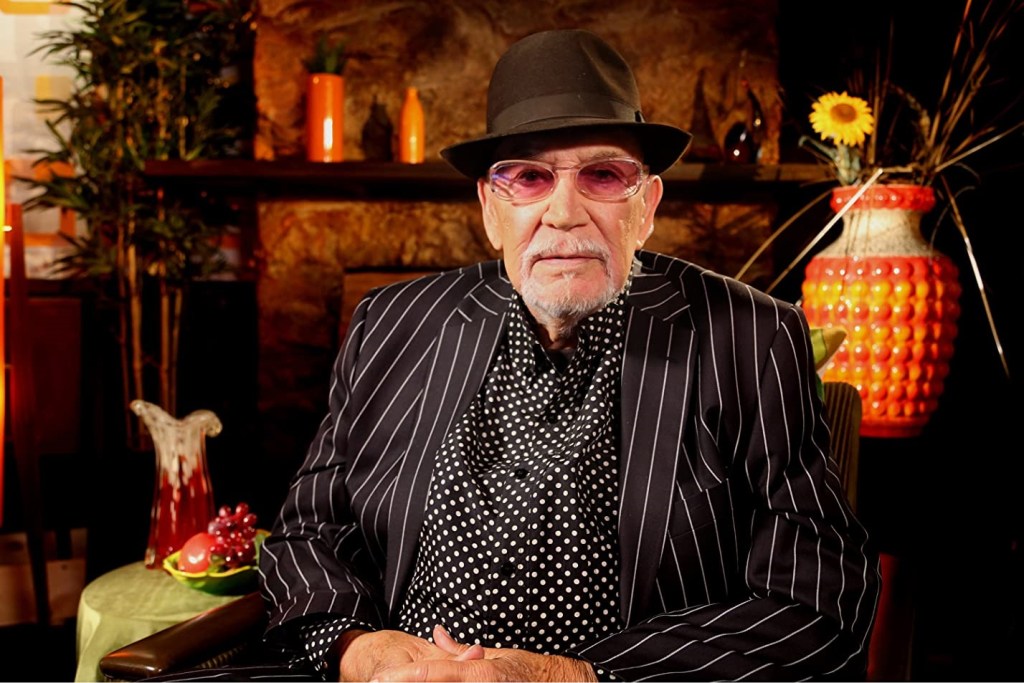
What follows is one of the most difficult interviews I’ve ever conducted. It also happens to be my favourite. As I’m reading it back, one which was conducted a year or so before Peter’s passing and will prove to be his last, I can still see the sparks flying. I wanted to try and keep Peter happy whilst also trying to make sure that I didn’t buckle under the weight of his sometimes barbed responses.
As a photographer and interviewer, I’ve been lucky to meet many of the people whom I idolised as a child, from Doctor Whos, on TV to big names on the big screen. It’s always a joy when you meet the actors who played these characters many years later to find they’re even larger in life. Such was the case with Peter Wyngarde.
Peter’s agent Thomas Bowington, who kindly arranged this interview and so brilliantly took over from Ed Mason at the London Film Fair many years ago, still thinks that I should have omitted certain questions, especially as regards to the casting of Night Of The Eagle, though mentioning the unmentionable play didn’t help!
This is an interview I wanted to go out as it was, as unexpurgated and unabridged as possible, so there it is. Hopefully it’s a fitting testament to the man. He may have been many characters on stage and screen but the most fascinating character was Peter himself and I’ll never forget having the privilege to sit and talk to him that early afternoon in November near Guy Fawkes Night, where the fireworks in the darkening skies outside were matched by those in the hotel lobby where we sat!

Peter Wyngarde’s to early life could be a film in itself and is certainly more eventful than many so-called biopics we see today. Due to his father being in the diplomatic service the young Peter found himself as well travelled as some of the playboys he later came to play as an adult. However, his later childhood was far from glamorous.
While his parents were away in India and the young Peter was staying with family friends in Shanghai, the Japanese Army invaded and took over its International Settlement. He, along with this surrogate family was interned in the notorious Lung Hua concentration camp.
Conditions in the camp was set to be horrific. Right as JG Ballard stated in his autobiography ‘Miracles Of Life’, Cyril Goldbert, the future Peter Wyngarde, was a fellow internee at Lung Hua camp.
Ballard later wrote of these times in his book ‘Empire Of The Sun’, filmed by Steven Spielberg. Peter’s younger siblings, Adolph Henry and Marion Simone, were under Swiss protection and thus exempt from internment and avoided some of the terrible things Peter endured, which included having his feet broken by rifle butts for running errands in the camp for other prisoners, and being put into confinement. To escape this harsh reality Peter began to work in the camp gardens then moved onto performing, giving the inmates his own version of Doctor Jekyll And Mr Hyde and by doing so transforming himself from Goldbert to Wyngarde.
After the camp was liberated, Peter was sent to a Swiss clinic for two years to recuperate from malnutrition, beri beri and malaria. He then finished his education in Switzerland, France and England. After studying law and advertising he returned to his love of acting and was cast as an understudy in place sfrom Birmingham to Brighton.
From there he progressed quickly to leading roles in Taming Of The Shrew as well as treading the boards at the Old Vic in Bristol and turning his hand to directing with A Long Day’s Journey Into Night.
In 1956, just over a decade since the end of hostilities and his internment, he found himself in the United States starring alongside Richard Burton and Fredric March (who once won an Oscar for playing Dr Jekyll and Mr Hyde himself) in Robert Rossen’s epic Alexander The Great. This is the point where we take up the story with Peter himself.

Peter, after returning from Hollywood with what you described as disillusionment after filming Alexander the Great, you became friends with Laurence Olivier through your friendship with his then-wife (Vivien Leigh). It was Olivier who tempted you back to the States to star on Broadway where you won ‘The Best Actor In A Foreign Play’ [award] in 1959. How did this all come about?
I thought it was earlier than that. I did a play at the Theatre Royal in Windsor, fantastic theatre. They had both come to see Heather Stannard as he was looking for a leading lady for a new play written especially by Christopher Fry at the time. We were suddenly told, Lord and Lady Olivier are in to see the play. Of course everyone started to pick up like rats after that! I had the idea to play my part like Paul Scofield (A Man For All Seasons) for some reason, so that’s what I did. I don’t know why. I’ve done terrible things like that before like play a character in the style of Noël Coward for some reason, which got me the sack. I did it rather well I thought. However on this occasion Olivier ignored me completely as he was there to see Heather Stannard.
Then I did The Good Woman Of Setzuan by Berthold Brecht, with Dame Peggy Ashcroft. She (Vivien Leigh) had told me I had to audition for a play she was going to do (Duel of Angels) with Fry. I did the audition as it was the great Jean-Louis Barrault (Les Enfants De Paradise) who was directing and we got on very well.
You returned to England to start in the controversial Siege of Sidney Street as well as in such popular TV programmes as Armchair Theatre before starring in The Innocents with Deborah Kerr. Although it was a small part you made quite an impact as Peter Quint.
Small part! What do you mean small part?
I mean in screen time, in The Innocents. What was Deborah Kerr like to work with?
Well, we both thought one day to star in the unmentionable play together.
Macbeth?
(Rather annoyed). You shouldn’t mention that! Get yourself up there and turn around three times! (This is an old actor superstition so as not to curse the player or the actor or the theatre, I don’t know people seem to have died during Hamlet and Macbeth through the years).
My apologies! JK Rowling obviously stole that for Voldemort in ‘Harry Potter’!
(Unamused at the reference). I’m serious. Do it.
(After doing it in the hope the interview will continue). Back to The Innocents?
Deborah Kerr was marvellous. She was a wonderful actress and very professional. We’re talking about a film that was taken from probably the best short ghost story ever written. However, I think she was miscast, as the Governess should be someone who is unattractive. She should be someone almost ugly who adores these children. She was incredible.
As you said, the film was based on the Henry James classic ‘The Turn of The Screw’ and was also very controversial at the time in its depiction of children possessed by adult spirits, especially in the scene where the young child kisses his nanny, which is even more shocking today. It’s a very striking film and its look and especially your character within it benefits from it being shot in black and white, giving it a very dreamlike look, especially in the scenes where you appear at a rain-soaked window! What are your memories of making the film?
We did a thing in the scene you mentioned where she comes along the corridor and pauses, which they initially shot without me. When we saw the rushes it simply didn’t work. Jack Clayton (director) turned to me and said, ‘See what you can do with it’. There was no reaction from her character to the situation she was in and she left the scene very disappointed and angry with herself. So I said, don’t be angry Deborah, let’s do it again. So, we shot the scene again with me in it. We went to see these rushes the next day and I took my small dog with me. When it gets to the scene where she’s walking down the corridor and Quint is behind the glass he (the dog) starts growling so something was happening! So she told me afterwards that she felt the hair standing up on the back of her neck and it worked, not simply because I was in it but that we were both in it playing the characters correctly.
Yes, the most famous still from the film is that scene, with Quint half hidden behind the rain-streaked window, it’s incredibly atmospheric. Your next film was and still is, one of the most undervalued films in horror history Night of the Eagle (aka Burn Which Burn). It is the final piece of the jigsaw that makes up the great trilogy of supernatural films of the late 50s and early 60s; the oldest being your previous film The Innocents and Jacks Turner’s Night of The Demon (aka Curse of the Demon), with Dana Andrews, based on the an M.R. James short story Casting The Runes. Although you were the mute threat in The Innocents, you are the dashing and erudite leading man. Your naturalistic performance and those of the entire cast elevate this film into an absolute classic of the genre. Are you a surprised as I am that a film of such strength, penned as it was by Charles Beaumont, George Baxter and the great Richard Matheson, wasn’t a hit at the time?
Well, the reason it wasn’t a success is because it was absolute rubbish. The original script was simply terrible. Crap.
But the script was by Richard Matheson, one of the great horror and fantasy writers of all time (I Am Legend and The Incredible Shrinking Man)!
Matheson? A crap cunt!
Really? I think he’s a genius and one of my favourite writers.
Well, if the script I got was anything to go by, I certainly don’t! I threw the script out of the window! I then walked down to High Street Kensington (where this interview is taking place ) in a rage, because I thought it was such a load of rubbish, when I saw this car in the window of Crooks. It was a Bristol 405. I went in and said, “I like that car, how much is it?” He said ‘£5,7s and tuppence,’ so I phoned up my bank and said ‘How much money have I got? And they said ‘’13 shillings and sixpence’, so I phoned up my agents and said, ‘So, you know that MARVELLOUS script I received today, it’s fantastic, can we please do it (laugh). That’s how we did it. What I did was throw all the rubbish out.
So, you had a lot to do with its overall film? As I said I think it’s one of the most naturalistic performances of that. The lines seemed to be acted on rather than acted out? That’s the thing I think that elevates the film from those although more stagy offerings.
Well, he (Matheson) got all the credit; he’s dead now isn’t he? It was rubbish. B movie to the fore. We went to see the premiere at the Hippodrome in Piccadilly and there was absolutely nobody in the audience. I went with John Schlesinger, Alan Bates and someone else. There was nobody in the cinema! It was the premiere! Nobody saw it at all and nobody went to see it again.
I believe you were the third Peter that was offered the main role after Peter Finch and Peter Cushing had passed on it.
I don’t know where you get this information. Peter Finch and Peter Cushing were with my agent. Where did you get this crap?
Well, mainly because it’s well documented in several books and articles, but the good thing is that you have just dispelled that, if that’s the case will stop if that’s not so?
Can we move on to something else?
Certainly. You moved away from film to TV for most of the 60s. Saying that the programmes you starred in are probably as iconic as any film from that celebrated decade, the parts as you did in The Avengers, I Love Lucy, The Champions, The Baron, I Spy, The Saint and famously as Number Two in The Prisoner. The episode of The Avengers called A Touch of Brimstone, based on the Hellfire Club, is now one of its most celebrated and notorious as it was banned in certain places. What was it like to work on?
Marvellous. It was great fun. I did two or three, that’s right, two. Yes, they banned that one in America. Are we going to go through my career? I know all these things. Why are you asking?
Because a lot of people will be interested in your views on them, Peter. For example, that one episode leads to you having a Marvel Comic character named and based on you.
Surprised and now rather interested really? What was that?
It’s a character in the very popular X-Men comics, called Jason Wyngarde (aka Mastermind), a cross between Jason King which followed and your own surname.
Oh yes, I know of that. I think they’re marvellous, although it should have the knighthood mentioned. They shouldn’t leave that out.
What was Diana Rigg like to work with?
Marvellous, completely professional. Now, we started getting off on the wrong foot and there are other things I’d like to talk about now we’ve got all that fluff out of the way.
Certainly, please go ahead.
Both Diana and Deborah were wonderful. Vivien was wonderful. They are all professional actresses who happened to be universal stars and who also happened to be totally professional people and what I learned from them was how to behave as an actor. Respect to them and the audience. Vivien always taught me that when you come onto the stage you must remember that there is an audience there who have paid to see you. So, the first thing you have to do is charm them.
I’d really like to touch on The Prisoner if we could, as it has such a huge following. You were good friends with Patrick McGoohan I believe?
Brilliant. It was an absolutely brilliant idea and conception. He had an enormous talent I thought. I was just sorry he went to Hollywood. I think he should have stayed here if he could have beard it. He had so much talent not only as an actor but as a director and conceptionalist.
The fact that he already had an usually popular programme like Danger Man and took it off in a completely different direction was incredibly brave.
(Ruffled again) Oh, so you’re telling him how he should do it now are you?
No, I’m saying how wonderful it was and how clever he was back then. To go to the men with the money and say, ‘this is where I want to take this simply wouldn’t happen now.
No. Men like Lew Grade. He didn’t know what was on his mind and nobody else did either. The concept was wonderful.
Did you have any input yourself?
No, I followed him religiously because it was his conception. It was wonderful and original. It was exciting and bizarre, but mainly because it was so original. I wish I had gone on in it, that’s the other thing, I regretted that the characters didn’t go beyond as it could have been very interesting.
Yes, fans bemoan the fact that only so few were made but isn’t it better to have something so encapsulating then dragging something out and diluting the premise? I think it’s a masterstroke, although the ending was never absolute, like many of the plots themselves. Did you stay in touch with Patrick when he went to Hollywood?
No. There was no reason sadly. I think he made a mistake going to Hollywood.
Peter, could you touch on your recording career? I’m a huge fan of the self-titled album you released in the early 70s, which found a new audience in the late 90s when it was re-released as ‘Sex Raises Its Ugly Head’! [1].
It’s a horrible title
Very strange. Again, it was quite controversial at the time, due to the song ‘Rape’.
Yes, I know. They wouldn’t play it on the BBC. It was so silly.
Perhaps they simply didn’t see it as the pastiche I believe it was meant to be. The faux spoken opening when you let the girl in and turn the lights down and ask what perfume she’s wearing must have given them a clue! The stand-out track for me and one of my favourite tracks of that decade is ‘Neville Thumbcatch’, one of the great story songs and a psychedelic masterpiece. It’s played a lot on BBC6 so they obviously get it now!
Well, thank you but not guilty! That was the producers. I agree they made a masterpiece and it’s my favourite piece on it too. It came about through RCA, who phoned my agent and said “Would Peter do some songs or something”. He said “What do you mean” and they said, “Well, for example, would you ask him to sing some Frank Sinatra songs”. I said I can’t see why, as he’s done it awfully well himself! Why on earth would you want me to cripple my voice as he sings so fantastically? How dare you ask me? So they asked what could you do? I said “I’d like to do something where I’m entertaining someone, she arrives and comes through the door and we take it from there”. It’s a camp send-up of Jason King!
Did you have a large contribution to the overall feel of the album?

Well, I wrote most of it myself, bar ‘Neville Thumbcatch’. It was supposed to be Jason King sending himself up.
I find it interesting that you did that at the height of that character’s popularity. That was quite audacious. Did the impact of Jason King simply just get too big?
Yes, several times out of all proportion! It got to the stage where I couldn’t walk in any capital in Europe without getting mobbed. It was like The Beatles. For example in Norway or Denmark, I can’t remember which one. I was given the Royal Suite, which I thought was ridiculous. I mean why? Just because I’m an actor playing a part should I be given this ridiculous honour? I didn’t like it at all. I remember going on the balcony and looking down and there were all these people, which is why I’m convinced any actor could become president for the same reason.
Were you surprised at the sheer amount of success? Department S was where the character started but it wasn’t long before he had his own show?
David Frost at had programme on a Saturday night, The Frost Report, which was going rather well but it was waning, it was going down and down, and some little guy, I’ve never met him, saw Department S and liked it so much he swapped it for the Frost programme and that’s how it went out, without any warning. After, the BBC, lines were jammed with people asking who is this Jason King, we want more of him.
Which led to the character’s own show. You must have been in every magazine then. What was it like to be the rock star of prime time TV, with your image staring back at you from nearly every magazine cover?
It was impossible to walk in the street. I simply couldn’t do it, everyone was coming up to me. The reason I think it happened at the time – it was wanted. That’s what people wanted at that time. That’s what happened with The Beatles, The Rolling Stones. I became an icon for no reason, by the fact that they wanted it at the time. They wanted someone who was well dressed, charming and he was funny and could send himself up. It was that quality that they really liked, the thing of someone completely different.
Was he the anti-James Bond?
Exactly, he was sending himself up. It was just what people wanted and it was perfect timing. It wouldn’t work now.
Well people thought Austin Powers was just a send up of James Bond but I think it was just as inspired by Jason King as Bond. Did the success enable you to do exactly what you wanted and were you tempted to go back to the theatre?
I’m mad about films. I love films more than anything. I also love acting. For me my ideal thing is directing. I did a little on Jason king but what I love is directing and writing. I did a lot of rewriting on Jason King. I was doing that every night and I think that’s why they were successful as there wasn’t a character like it.
In one of your most famous roles you wore a mask at all times, as Klytus in Flash Gordon. Although you have your face covered, there’s a sense of power that emanated from behind that mask, a sense of nobility. But you must have thought ‘What can I bring to this part as I’m behind the mask?’
Yes. Well it was a tremendous amount of trouble. Nothing was happening. When we first started, my voice came back as it was stopped by the mask. When we saw the rushes it was terrible and they said, “You can’t wear that bloody mask as we can’t hear you”. Nothing came through it, no power, nothing. It was very difficult. The mask just went for several thousand recently. The chap who bought it brought it to the 35th Anniversary to show me. When he handed it to me I thought he was giving it back to me as a present, but he took it away again!
We mentioned Lew Grade but what was Dino de Laurentiis like to work with?
(Laughs). What a man! One day I was on the set. I was always on the set as the Fellini set and costumes were all around. And his secretary came to me and said he wants you to have tea with him on Thursday so I thought, I wonder what’s happening here as a long time ago I was put under contract at Paramount and in the first film I was asked to do I was an English policeman in Hong Kong. It was unbelievably trashy, to do with smuggling or something and I said, “Up yours, this really isn’t for me”, so they suspended me. The next script that came along was War and Peace and I thought I must do this. At the same time my neighbour Peter Schaffer (Sleuth, The Wicker Man) offered me a film script called The Salt Land which was a wonderful part so I started to do it. They were sort of Orson Welles spoken by John Gielgud. Impossible. Impossible to play. John Clements who was producing it said, “You can’t play this it’s impossible. You’ll need the presence of Welles and the vocal energy of Gielgud too! so I tried and of course I couldn’t do it. I couldn’t do Welles but it needed that stature. That kind of gravitas.
Halfway through I was called by Paramount as King Vidor was directing a test with Audrey Hepburn (for War and Peace). So I went over to do the test in Rome and that was it. Then just as we were finishing The Salt Land I got a call to say I needed to be in Rome the next morning but I still had at least a week to finish on The Salt Land. So I had to make up my mind either to finish this, THEN go to Rome as I wanted to do it. I’d done a lot on The Salt Land and I wanted to see how it came out but they said – delivered and intonated like a Victorian father, “If you don’t come out to Rome, goodbye to your Paramount contract, goodbye to War and Peace and goodbye to working with them again. So I was sacked. I finished The Salt Land and lost the contract and the part in War and Peace. Who played it? Henry Ford! Completely miscast. He was 100 years older than he should have been, and American with it.
Dino de Laurentiis was that film producer! Now we cut a Flash Gordon which he was also producing. But never told him that I was the one who was sacked but I was obviously worried. If I nearly had a heart attack. Actually, he just said nice things about me. I’d got to the office and his secretary said he had been away on business and was held up at Heathrow but not to leave, saying, “Please don’t go”. It turned out that why he’d gone to Amsterdam is that part of a set hadn’t been finished and they needed more money to get it finished! So he finally turned up and (said in Italian accent), “Sorry I’m so late but what I want to do with you is to make you The Invisible Man!” It would have been wonderful, if of course, if Flash Gordon had been a success. It wasn’t.
It did well in Europe but it didn’t do well elsewhere, because of a little cunt, a little prick of a cunt, did some videos of the whole film and sold them to a big American dealer. We were all going to do the US premieres. I was going to do New York because of my being on Broadway, and Max Von Sydow and the James Bond guy (Timothy Dalton), he was going to do Atlanta or something but we were all told to wait and then the whole lot was cancelled because of all these illegal videos. I wish I could find him now, I’d choke him!
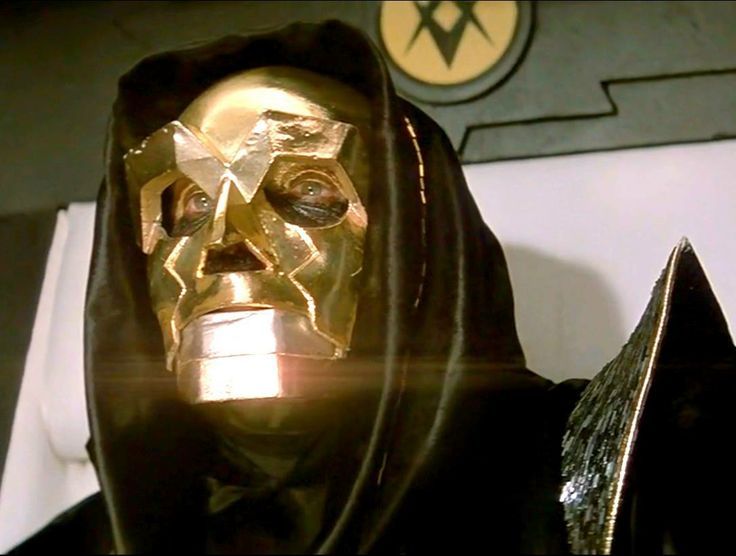
So, in fact, one person ruined the film for everyone involved in its making. Did you like the film?
Flash Gordon? I loved it! It had a marvellous opening. I got the first laugh! What was it – ‘Klytus, what plaything can you offer me today/’ and I said, what was it again? “A planet in the SK system. It’s inhabitants call it EAARTTHHH”. That’s right. He started the whole thing off. It was a wonderful film.
You said at the 35th Anniversary showing that it was a group experience. Well there’s a money maker right there, just like The Rocky Horror Show!
They should re-release it. It’s much better in the cinema with audience participation.
Were there plans to continue the character from Flash Gordon? It has been rumoured that there were.
I’m not sure we should mention that, but as it’s so long ago, I’ll tell you. I’d rather not tell too many secrets as it isn’t that known publicly. The idea was that after the spike went into Ming’s chest and he falls down at the end, a black hand comes in with the Klytus insignia and then there’s a question mark. That’s because what the author wanted to do was to have Klytus come back and because of the power of the ring, build an empire of his own and it happens, in Atlantis, under the water! That’s what would have happened if it wasn’t for that little cunt spoiling things, especially for me. I suppose that it could still be done but that’s up to them. Nothing to stop it. The underwater theme would have been wonderful with all those gigantic sets.
There was a series with Ray ‘Crash’ Corrigan, made the same year (1936) that the original Flash was released that had a lot in common with that, it was called Undersea Kingdom, so perhaps that’s where the idea for that came from. So that idea was there before all this. It was full of all sorts, even robots!
It would have been wonderful. Are we finished now?
Certainly, and I’m glad we went off on a tangent as we did.
Well, that was down to you!
(Laughs). Peter, before you go could I ask one thing? If Jason King, like Austin Powers, had been frozen in the late 60s and re-emerged today, what do you think he’d say about life in London; in the London of today in his ineffable style?
He’d just go straight back to sleep! It’s all about TV now. If you are seeing enough of that, people will see you as an idol, even if you are in a toothpaste commercial. Imagine what would have happened if Hitler had television? Just think about it. The horror of that thought is terrifying. If Germany had had television then we’d have been kaput! What’s going to happen with Trump? That’s the proof in itself. That’s one reason why Jason would simply want to go back to sleep! (Laughs).
_____________________
I would like to thank Thomas Bowington of Bowington Management for arranging the interview as well as his help in understanding and who, as a friend as well as agent, Peter the man rather than just Peter the icon.
As Thomas said, Peter gave very few interviews so this last one really was a journey on a road less travel. Covering the ground we did, hopefully gave us all a better view of things, especially now insightful.
Interview by Mark Mawston.
Notes:
[1]. The CD was actually entitled, ‘When Sex Leers It’s Inquisitive Head’.
© Copyright The Hellfire Club: The OFFICIAL PETER WYNGARDE Appreciation Society: https://www.facebook.com/groups/813997125389790/
 PETER WYNGARDE: The Official Website
One thought on “INTERVIEW: Infinity Magazine”