


Please note that some of the additional information provided here by the journalist named below may not be accurate, so it should be treated with caution.
October 1996
Back in 1970, Peter Wyngarde was a household name as TV sleuth Jason King. Today is an idol of musical exotica thanks to a remarkable solo album.
He’s acted alongside Vivien Leigh, and was once tipped as a second Olivier, during a remarkably successful stage and screen career throughout the 50s and 60s. Then, in 1968, Peter Wyngarde was invited to play the part of crime fiction writer Jason King for a new television series called Department S. Two series later, King had his own show: the plots became more outrageous, as did Jason King’s wardrobe and haughty manner.
Back then, he topped ‘Sexiest Man’ polls, and was mobbed by thousands of fans as he touched down in Australia. Today, Wyngarde’s Jason King is equally irresistible as the most perfect embodiment of the reborn Easy aesthetic. Which is why EMI’s Sound Gallery schemer, Tris Penna, invited the man who was once King to write something for the sleeve of the second volume of the Sound Gallery; a tribute to legendary TV theme orchestrator, Laurie Johnson, penned in a manner that suggests the intervening 25 years had done little to cramp Wyngarde unique lyrics style: “Even them that are totally improbable/he manages is to invest with Emmy possibilities/And entirely personal, that’s quite indominable/Jason, Kingable.”
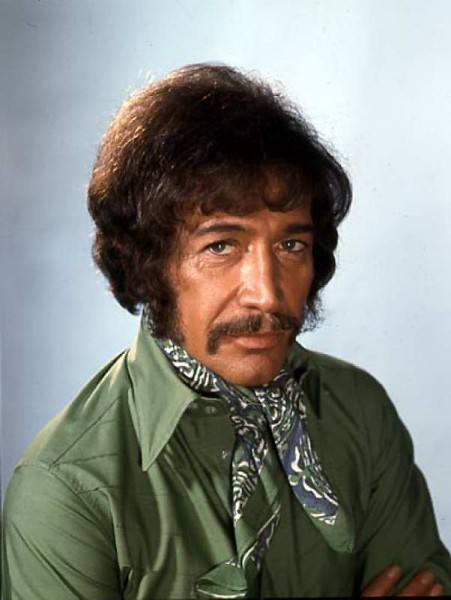
“I thought it was rather good,” says Wyngarde, munching on a King Prawn Thermidor in at distinguished eaterie in a nice part of town. He’s still recognisably King-like, the Mexican bandit moustache is still there, although that once luxurious bouffant is slowly losing the follicular challenge. Self-ridicule has tended to soften those rugged features, and today, Wyngarde could be mistaken for Peter O’Toole’s more handsome younger brother. But he isn’t: in fact, everything about him suggests that there’s a good deal of Jason King still lurking about.
“Oh, it was easy to get back into character
again,” he smiles. “Jason King was very much a romantic extension, a magnification of me anyway. I rewrote the scripts and developed the character to suit, and lived it 12 hours a day for four years.”
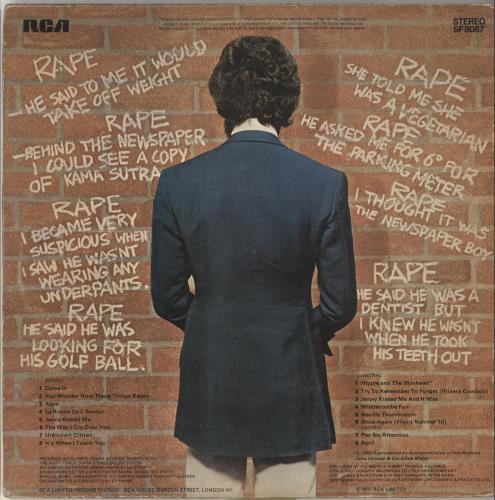
I don’t have a modern-day equivalent of Felicity Kendal or Diana Rigg to offer as sacrificial fodder for the patter of Jason King’s unflappable seduction techniques, but I do have in my bag one highly cherished copy of Peter Wyngarde’s album recorded for RCA in 1970. When I first purchased the record, it was worthless. Advertising in this magazine for one in better condition in 1986, I happily forked out £15. Now, no dealer would stick a copy out for less than £200. Why? It’s a masterpiece of fine, pseudo psychedelic orchestrations and impeccable bad taste; of the double-entandre, where symbolic fantasy collides with real-world impropriety; and of a lifestyle so preposterous that it’s barely recognisable.
Cherished by the Exotic and Easy crowd, the Peter Wyngarde LP has also found favour in other circles, according to the man who could charm the pants off a nun. “I heard it enjoyed a huge cult following amongst modern-day hippies who got stoned to it in Amsterdam,” he says. The record has even inspired several tributes, most notably Breadwinner’s ‘Give Us A Light, You Bastard’ private album, taped in 1990, which boasted three songs – ‘If Wyngarde Was A Woman’, ‘Hey There, Petter (sic) Wyngarde’ and ‘Jason Kinky Winky’, all performed in the manner of the great man’s own LP.
So out on a limb that it could easily have been recorded by a Martian, the Wyngarde album actually shares something in common with one or two cherish rock records. ‘God Save The Queen’, ‘Give Ireland Back To The Irish’, ‘Relax’ and ‘Hi, Hi, Hi’ all met a frosty reception when it came to getting radio play. But it’s with a wry smile that Wyngarde recalls that his entire album was banned from public dissemination.
“Sold out in three or four days, but RCA didn’t repress it. I got in a rage about that because I had signed a contract for three LPs, one a year. They told me that the main factory has just being closed and that they were opening a new one in Hollywood. That’s Hollywood in Gloucestershire. Perfectly truthful. It wasn’t going to open for another six months.
“They had this LP that had struck lucky. None of their other LPs had done that since Elvis; he was all they had. They said it would have to wait six months, by which time the momentum was lost.”
That episode, which has more than a whiff of conspiracy about it, helps explain the incredible scarcity of the album today. And a listen to the opening, highly theatrical sequence, comprising ‘Come In’, ‘You Wonder These Things Begin’ and
the infamous ‘Rape’, suggests that RCA got more than they bargained for after giving Wyngarde carte blanche for the record. It’s no more than they deserved, insist Wyngarde, who later discovered that the record was intended as a tax loss. “When they discovered that it wasn’t a tax loss but a tax gain, it floored them!”
Wondering what the legion of admirers, many of whom showered Wyngarde with suggestive letters, would have made of it only enounces the listening experience. The record opens with the sound of inane laughter, which gives way to a savage funky drummer rhythm, topped with a tumultuous horn arrangement. The mood distinctly changes as Wyngarde prepares to welcome his unsuspecting visitor – a candle is lit, some champagne is opened and he lights the first cigarette of the evening, while humming in French to himself.
If this don’t sound like your average celebrity record, then what follows over the next seven or eight minutes is palatable only in its sheer perversity. One is reminded of Dali’s reaction to the murder of his friend, Lorca, during the Spanish Civil War: “Olé!” Could hardly be deemed etiquette.
Neither was the notion that Jason King (Wyngarde makes that it’s King during the piece) might indeed be a potential rapist. But that’s exactly what unfolds, as an idealistic dream-seduction sequence is brutally shattered by the return of those menacing horns. Enter a transformed Jason King, growling “rape” like a rabid, salivating werewolf intent on devouring the microphone, a scream and a Gregorian chant pile on further layers of unlikeliness. ‘King’, ever the international playboy, then offers a bizarre gazetteer of rape around the world, before a conciliatory “which makes the whole thing rather nasty, tasteless and rather hasty, but as Jason King would say, it depends so much on what you… fancy.”
It’s just possible that what starts out as ”a pleasant evening… and a few surprises” is in fact a savage satire on smooth man. However, Wyngarde feels no compunction to defend the song. “Is it politically incorrect?” he enquires. “Why is it politically incorrect? I’m sure rape is not frivolous, but it’s not intended to be physical rape. It’s about all different kinds of rape within marriage, rape of different countries, even.

“We’re now talking everything so literally, lacking the humour which is so vitally important. The reason why George Bernard Shaw worked as a socialist is simply because he made it funny. Even when things are horrible, you cannot talk about them. That’s what the Victorians did.
“All the problems of the world are because people don’t laugh. That’s much more dangerous. My album to be heard all over the place. Is totally fun.”
No question about the total fun of ‘Hippie And The Skinhead’. Inspired by a letter to The Sunday Times, in praise of Skinhead culture over “dirty” hippies. Wyngarde came up with an extraordinarily delivered tale of an encounter between gay long-hair Billy and a queer-bashing skinhead named Kenny, outside a public lavatory in Piccadilly.
Well the song ends up with the discovery that Billy is in fact an ample-chested woman in drag, Wyngarde insists that if he wrote the song today, he would have had them “going off into the sunset together,” adding that attitudes have “all changed now”.
Though the album’s appeal is largely down to the meeting of Wyngarde’s fertile imagination and its relationship with the Jason King persona. Peter is generous in his praise for his collaborators, Vic Smith and the Valverde brothers, who co-produced the record and co-wrote the music.
The Valverdes were Maltese brothers who went out as a guitar-playing due. “They first raised the idea of making a record.” Wyngarde recalls. “I wrote lyrics for some songs of theirs, which they then toured with. But I didn’t take them very seriously until this offer came up. And I was literally sitting on the loo listening to some of the tapes they’d sent me, when I started to write material for the record. It’s the best place for concentrate.”
The finishing touches were all put in place by Vic Smith, which also brought his ‘Neville Thumbcatch” song (previously covered by The Attack) with him for Wyngarde to cover. “He put the record together brilliantly,” says Peter, adding that the LP took about a week to complete at London’s prestigious Olympic Studios.
Wyngarde’s place in popular culture’s cult corner is assured by his crazy record and the creation of the Jason King character, now enjoying a new lease of life on Bravo, which is currently re-running episodes of Department S and Jason King.
We all know that Jason King remains an exceptional symbol of Easy elegance. But back in the days of extended sidies and slim-fit blazers, did Wyngarde’s bachelor pad really swing to the sounds of Roy Budd, Burt Bacharach and those other lords of leisure sound? “Of course it did,” he says, “Raindrops Keep Falling On My Head” was a great favourite of mine”.
Work hasn’t been so easy to find post Jason King, but Wyngarde still retains an exceptional fondness for the crime-writing sleuth he created: “Millstone’s the wrong word. You create something and it’s like a child in millstone. He’s a lovely character.” Of course he’s maverick, sense of humour an’ all.
Interview by Mark Paytress.

 PETER WYNGARDE: The Official Website
One thought on “INTERVIEW: Record Collector”