PART OF THE OFFICIAL PETER WYNGARDE APPRECIATION SOCIETY
REVIEW: Negative Evidence
Broadcast: Tuesday, 7th February, 1961
Character: Major Peter Brayling
The Story
The play is set in the (fictional) Far Eastern state of Koaran, which is under British colonial rule.
The Governor of the university in the territorial capital of Sawalli is Entomologist, Dr Charles Brayling (Laidman Browne) whose son, Peter (Peter Wyngarde), is a Major in the British Army – a Company of which are stationed at Fort Melenby on the outskirts of the City.
In the opening scene, Dr Brayling is found in his office discussing his subject with local politician, Sir John Callington (William Fox). Together they’re standing in front of a glass case containing specimens of indigenous species of insects, which Brayling describes as being representative of all the people they know within the British community – including his own son, whose personality he likens to a large spider which takes pride of place in the display.
Peter’s mother (Vivienne Bennett) dotes on her son, and in spite of his philandering and point blank refusal to marry and settle down, will hear nothing unfavourable said about her darling boy, even from her more judicious husband.
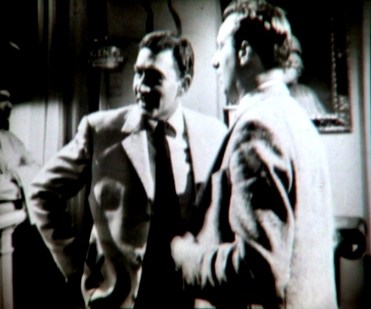
Left: Peter – center, standing
For some time, Major Brayling had been dating Diana Claveney (Susan Marryott) but, of late, appears to have tired of her. However, there’s someone else who’s eager to take Peter’s place in Diane’s affections, namely Alec Felson (Paul Eddington) – a Botanist at the University. Regrettably for him, Diane is still in love with the Major, which causes no end of resentment on Felson’s part.
Over recent months, the British community in the Capital have repeatedly fallen victim to terrorists who’re loyal to the Koarani State. It’s Major Brayling’s duty as Commander of the Army Garrison in Sawalli to maintain order, and to keep its residents safe.During a routine patrol of the border between Koarani and a neighbouring state, Major Brayling and his subordinate, Sergeant, Aspery, spot a group of men who Brayling believes are insurgents, so the two soldiers track them for almost two miles across the frontier, until they observe the group taking refuge in a Buddhist temple.
When the rebels begin to stubbornly defend the Shrine, Brayling’s suspicions are realised, and he feels justified in crossing the border and attacking the Temple. Once the firing ceases and the Major’s able to gain entry to the building, he begins to tear it apart as he hunts for evidence of the rebels activities. During his search he happens upon a cellar, where he finds a terrified man dressed in the robes of a Buddhist Monk. The young Officer immediately sets about grilling the man; believing him to be part of the terrorist cell. In spite of the ‘Monks’ inability to give Brayling the information he demands, the Officer continues to push for answers until, inexorably, his captive expires under the weight of interrogation.
The Major decides to intern the body of the ‘Monk’ in the cellar, and returns to Sergeant Aspery, who’d been injured during the exchange of gunfire. With his wounded comrade slung over his shoulder, Brayling sets off on the gruelling march back to Fort Melenby, where he reports finding inside the temple a printing press used by the rebels to manufacture propaganda leaflets.
He immediately orders another of his juniors officers – Lieutenant Varden (John Ronane), to take a group of villagers with him to the Shrine to retrieve the Press and any other materials they find there. Yet, in spite of the Major giving Varden detailed directions on how to reach the Temple, the Lieutenant somehow manages loses his way in the dark, thereby reaching his destination several hours later than intended. By that time, the Press and its generator, plus all the photographic equipment described by Brayling, have disappeared.
Right: Peter and Paul Eddington as Alec Felson
What Vaden does find, however, is the body of the ‘Monk’ that the Major had concealed in the cellar earlier that day. When Vaden reports on what he’d seen at the Temple, the Major suggests that the insurgents must’ve removed the Printing Press and accompanying materials during the time it’d taken him to return to the Fort, and the Lieutenant reaching the Temple. But whilst his family and closest friends are willing to take Brayling’s word as gospel, the Army immediately begin an investigation into what had happened during the action, which requires the Major to spend the majority of his leave at Fort Melenby.
The gravity of the Army inquest seemingly has little effect on the Major’s dash, as a couple of evenings later he turns up at a local bar to get together his parents, complete with a new girl on his arm. There, too, is Diana – dejected and forlorn, yearning for him to spare her a glance.
At the same watering hole is university Botanist, Alec Felson, who’s seated with Lieutenant Varden – the latter of whom appears more than a little anxious at the mention of the Military Inquiry. Felson is already aware that his drinking companion has tendered a request to leave Major Brayling’s Company, and when pushed, the edgy Officer concedes that, unlike his Commander, he’s never been the “Paths of glory” type – believing himself better suited to the Education Corps which he hopes to join.
Alec senses that there’s something more to the Lieutenant’s sudden request for transfer, and that he might be concealing something. He therefore decides to divulge his own suspicions about what happened at the Temple, and produces a photograph of the Major that shows him with the bodies of two dead terrorists. Varden reveals that Brayling would often have such incident’s memorilaised, since he enjoyed being photographed with his “trophies”.
Felson asks if the Major had taken a camera with him on the evening he went out on patrol with Sergeant, Aspery. Varden confirms that he had. Then why, the Scientist queries, had he not photographed the printing press and other paraphernalia inside the Temple when he’d first come across it; did he not consider it judicious to take a snapshot to validate his story?
Varden remembers that the picture of the Major in Felson’s possession had been taken with the last exposure on a roll of film. Then why, Felson asks, did he bother to take the camera at all, unless there happened to be a second roll of film? He waits for a response from Varden, who confirms that there was indeed another roll in the camera when Brayling returned to the Fort. The Scientist speculates about what it might contain; a notion which the Lieutenant objects to – saying that it was unfair to hypothesise, given that the film had not yet been processed.
Felson swiftly points out that several days had now passed since the events at the Shrine, adding that there’d been plenty of time for the Major to have the film developed…. unless, of course, there was something that Brayling didn’t want anyone else to see?
There also appeared to be a question concerning the camera itself, since Brayling had asserted that some of the photographs which had come to light had not been taken with his camera at all. But Felson identifies a mark on the photograph in his custody that’d been caused, he claims, by a fault on the lens of Brayling’s camera. This detail had been brought to his attention by none other than Diana Claveney. However, as Lieutenant Varden is keen to point out, Ms Claveney had recently been spurned by the Major – and “Hell hath no fury like a woman scorned!”
Varden has heard enough. He warns Felson to stay out of things that don’t concern him. Realising that he’s getting nowhere with the Lieutenant, Alec decides to take his argument to Sir John Callington, who also happens to be frequenting the same bar. It becomes clear that the two men don’t particularly like each other, so it’s no surprise that the Peer is less than sympathetic to the accusations being aimed against the Major. Indeed, Sir John tells Felson that he has no justification in trying to ruin Brayling’s career, and warns him that by taking the matter to Paruder – the State Governor, as Alec threatens to do, he risks losing a huge grant that’d been promised to fund a new Botany labpratory at the University.
Meanwhile, Major Brayling finds Lieutenant Varden seated alone in the bar and approaches him to find out what he makes of Felson. The Junior Officer pauses for a moment, then declares that Alec gives the impression of “someone with a very vivid imagination”.
“So he might be easily persuaded?” the Major enquires, shrewdly. Varden confirms with a single word: “Yes”.
Leaning in to get a light for his cigarette, Brayling requests to know what he’d told Felson during their exchange: “To mind his own business!” the now visibly shaken Lieutenant replies.
Right: With John Ronane as Lieutenant Varden.
But Alec isn’t one for heeding such advice, and as he’d implied the previous evening, he goes to see Paruder (Patrick Cargill), to whom he relates the same theory he’d taken to Varden. On this occasion, however, he introduces the additional premise that the man found in the Temple cellar had not been part of the terrorist faction at all, but was exactly what he’d appeared to be; a Buddhist Monk tending the Shrine. In that case, Brayling was nothing but a cold-blooded murderer.
Paruder merely grins at the suggestion, and recommends that the Botanist would make an excellent screenwriter. Infuriated, Alec produces the same photograph that he’d shown to Varden at the bar on the previous evening, which he maintains had been snapped with Brayling’s camera. To prove his point, he shows the Governor the mark on the print which he believes is unique.
Paruder rises purposefully from his chair and picks up a framed portrait of his eldest daughter from a ledge adjacent to his desk. He tells Felson that the picture had been taken in his garden by a friend of his. The print bears the same mark as the one retained by Alec, and yet it’s certain that the mounted image had not been taken with Major Brayling’s camera. Paruda explains to a deflated Alec, that the fault is generic to all camera lenses produced in Koaran. Alec’s “evidence” therefore proves nothing.
In Retrospect
Political Correctness Alert
The play ends without a clear or decisive conclusion, thereby leaving Major Brayling’s guilt or innocence open to the viewer’s own interpretation.
The impressions we’re given of each of the characters is ‘assumed’ by the other personalities in the story. For instance, Major Peter Brayling’s Entomologist father sets the tone by comparing his son to a deadly spider in his collection of insects.
The doting mother is convinced that Felson hates Peter, because Diane Claveney – the woman Alec desires, is still hopelessly in love with the young Officer.
Lieutenant Varden’s proposition, meanwhile, that the spurned Claveney had implicated Brayling as reimbursement for his infidelity.
We than have Sir John Callington who admits to there being a mutual dislike between himself and Alec Felson, whilst openly admiring the Major – a regard he shares with the State Governor, Paruda.
And finally, we have Lieutenant Varden who’s hastily submitted a request to transfer out of Brayling’s Command – he says, to join the Education Corps.
Based on the above, we begin to get two very differing depictions of Major Brayling. Whilst his father obviously adores his son, he’s not quite as blind to his shortcomings as his mother is. The comparison he makes between Peter and the poisonous arachnid in his collection suggests that the Major has a deadly side to his nature.
Although blinded by her love for her son, Brayling’s mother, is astute enough to notice the Botanist’s eye for Diane Claveney, which would suggest a purpose for Felson’s dogged determination to see the Major charged with murder. With Brayling out of the picture, Alec would stand more chance of winning Diane’s heart.
Lieutenant Varden’s argument that Ms Claveney had acted out of malice by supplying Felson with technical advice regarding the fault on the camera lens, could be viewed from two different angles:
1. Might she have done it to implicate Peter Brayling in murder, as Varden suggests? Or,
2. Were her actions designed merely to make Felson look foolish, thereby taking the heat off her former lover?
We now come to Sir John Callington: a well-respected politician, who plainly has little deference for Felson, but who holds the Major in high regard. This leaves us questioning who’s really the villain here?
Alternatively, the twitchy Lieutenant Varden appears genuinely troubled. Is the reason for his wanting to join the Education Corps. genuine, or is it merely an attempting to distance himself from the Major?
Certainly, Felson’s version of events are pure speculation, given that he’s not a serving Army officer, nor was he an eyewitness to the events that took place at the Temple. His inference that body found in the cellar of the Shrine was that of a simple Buddhist Monk and not an insurgent as claimed, is merely conjecture. His speculation about what is contained on the second roll of film in Brayling’s camera is shot down in flames by Varden, as are his conclusions regarding the blemish left on the photograph by the poor-quality lens.
Certainly, Brayling had breached protocol by crossing the frontier whilst in pursuit of the suspected terrorists, but even Paruder advocates that the Army would overlook such an abuse if he was “able to bring something back”.
Lieutenant Varden describes Major Brayling as a man who enjoys “shooting Nig-Nogs”, which would imply that he had little respect for the native population – regardless of whether they are deemed to be enemy or not. To such a man, the ‘Monk’ in the Temple cellar would simply be viewed as nothing other than collateral damage, whether he was culpable of aiding the insurgents or not.
Un-P.C. language aside, ‘Negative Evidence’ is an intriguing piece of television, which was broadcast live. It was meticulously written, well-acted and utterly thought-provoking.
Critics Comment
‘Negative Evidence was interesting (as almost any play with Peter Wyngarde in it is bound to be. He has such a dynamic personality, he makes other players seem like shadows), but there was rather too much technical blather and the women characters were wholly unbelievable.I never for one movement believed Peter Brayling was guilty of the crimes that the immature little toad, Felson, tried to pin on him, and neither would his Mother and fiancé. No woman who had loved and was engaged to such a man would betray him in the way she did, and the Mother showed a total lack of understanding of the female mind in making her behave in such a manner, however disappointed she may have been in him as a once prospective husband. But then, perhaps, only a woman can write convincingly about the inner workings of a woman’s mind. a man can only go by guesswork.




 PETER WYNGARDE: The Official Website
2 thoughts on “REVIEW: Negative Evidence”