


Broadcast: Friday, 7th June, 1957
Character: Mustafa
The Story
Playwrights like to have a setting that’s self-contained, such as a lifeboat at sea, a tiny flat, or a country house. In this play author, Evan Jones, put his characters in a refugee camp on the Gaza strip because he knew something about it, and because it seemed to him as good an image of the modern world as any of the above.
If any piece of territory qualifies for the title ‘God-forbidden’ the Gaza strip was it in the late 1940’s. There was nothing there but sand, a single crumbling town, and 250,000 unwanted people.
Below: Peter as Mustafa, with Leo McKern as Eddie
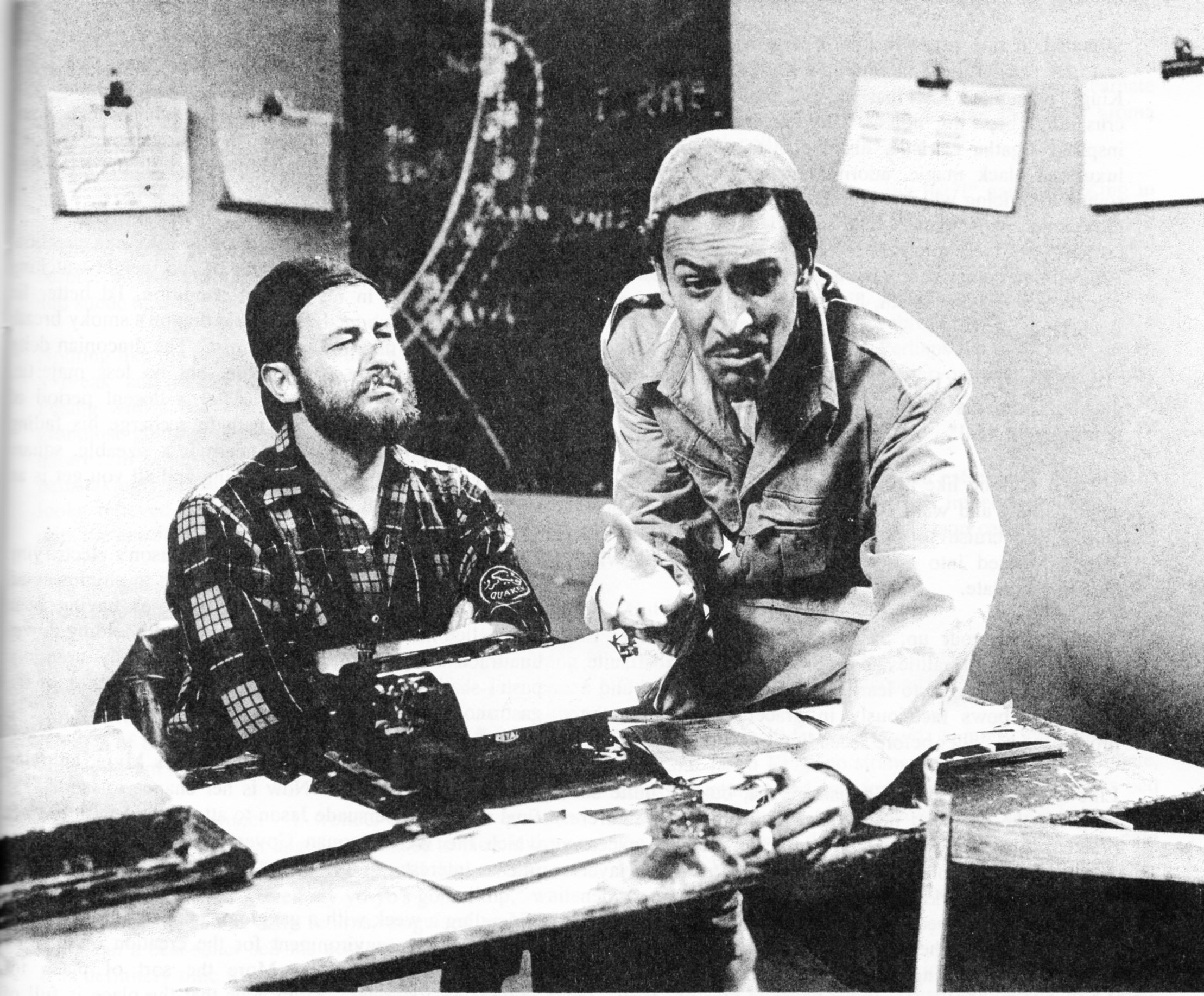
The refugees had lived in Gaza for almost a decade. Israel, overburdened with her own persecuted people, did not want them. The Arabs were already rich in poverty, and while the refugees remained they could maintain their quarrel with Israel. Although the conscience of the world would not let them die, the statesmen couldn’t find a solution to their problems. Meanwhile, the Arabs would not accept Israel because, to them, the country was a usurper of their ancient land; a western colony that brought ideas and techniques which threatened their way of life.
This was the background to ’The Widows of Jaffa’, but the play was not about politics – it was about people. In the 1940’s, the refugee camps were organised by a group of Quaker volunteers working for the United Nations. Their biggest problem was registration. This had to be done through the representatives of the refugees, since the only outside force was the corrupt and defeated Egyptian Army. In the interests of justice, the Registration Lists had to be accurate. The volunteers were strangers and outnumbered, but they had a weapon: the power of hunger.
‘The Widows of Jaffa’ was loosely based on the experiences of the author who, after completing his education at the small liberalised Quaker college of Harvard, Pennsylvania, went to Palestine with the American Friends Service Committee. The action takes place in 1949, several months after the Arab-Israeli War.
Soldiers were specifically excluded from the play, which tells the story of a newly-arrived Quaker missionary in one of the camps camp on the Strip.
The misery of this ‘waiting out of time’ and the appalling thought that such wretchedness could exist only a few hours away from the capitals of Europe were the predominant impressions taken from this powerful and wonderfully-acted drama.
Desperately wanting to know whether Christ’s teachings could be made to work, Camp Leader, Andrew – played by Patrick Allen, finds nothing but deception, cynicism and corruption around him.
In sharp contrast to the idealist Andrew, Camp Coordinator, Eddie (Leo McKern), is frustrated and disillusioned – wisecracking his way through one of the dirtiest jobs in the world. He and Andrew clash over almost everything, not least the Ration Lists that the team have been sent to make.
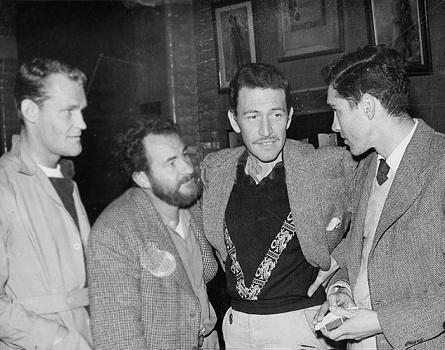
Left: Peter with Patrick Allan, Leo McKern and Evan Jones during a rehearsal for the play.
Additionally there’s interpreter, Mustafa (Peter Wyngarde), who is embittered by the loss of his homeland, and yet is torn between his allegiance to the Arabs and his attraction to the Westerners who he works for.
Into the mix comes merchant, Abu Mahmoud (Harold Kasket), who controls the Lists for his own personal profit; the boy, Abdel Rahman (Frank Aiello), who has known no life but that in the camps; and the eponymous widows of Jaffa, veiled from head to toe – pawns in a struggle for food.
It was to the credit of the three principal actors that they didn’t allow Jones’ philosophising to drown out the characters.
| ‘This play was written with fire and insight, and distinguished, too, by a beautiful performance from Mr Peter Wyngarde, whose voice is a gift even rarer than his striking look’s. The Sunday Times |

 PETER WYNGARDE: The Official Website
2 thoughts on “REVIEW: The Widows of Jaffa”