


Broadcast: Sunday, 5th January, 1958
Character: David Linden
‘The Linden’s are living a relatively happy, complacent life until Henry brings home his second wife. Their life is then disrupted and tragedy follows’.
Some Background
This play – part of the Armchair Theatre series (Season 2, Episode 17), was due to be broadcast on Sunday, 29th December, 1957, but as a result of a faulty microphone and crane camera breaking down. Great efforts were made to repair it in time for the live broadcast, but they failed. Rather than put on a makeshift production, without the use of the “Mole” camera which could be raised or lowered, the decision was taken by Canadian director, William ‘Ted’ Kotcheff, whose methods of production include great mobility of cameras, decided that the transmission could not go ahead, since the faulty equipment was integral to his plans. A “stock” film was shown in its place.
Spare parts for the broken crane were rushed in from London on the Monday, and were anxiously fitted and tested. To be on the safe side. A.B.C. a complete spare “Mole”, which weighed two tons, to be set up their studios in Manchester.
The drama, which was written by Keith Winter, was eventually shown on the following Sunday, which meant the cancellation of the telefilm, ‘Trial by Candlelight’. It also meant that one of the main players, Angela Baddley, had to be replaced by Marian Spencer at short notice since Ms. Baddley had planned to abroad on holiday during the first week in January. A.B.C. were fortunate that she was the only one who couldn’t alter arrangements to leave a further weekend free.
The production company released the following statement during the week beginning 30th December: “In fairness to Kotcheff and the play itself, the production was abandoned when it was found that repairs could not be effected in time.” There was no mention of fairness to the cast, who must’ve felt somewhat aggrieved when they realised that they were of secondary importance to a camera!
Thankfully, there were no more gremlins – at least with the equipment. Whilst four of the original cast members made the trek back to Manchester for a second time in a week, a certain Mr Wyngarde left them waiting to begin a camera rehearsal.
Thirty minutes went by, and still no Peter, and just as tempers were reaching breaking point, the great man arrived. Looking around at the solemn faces that greeted him, he quipped: “Don’t scold me. I meant to be late!”
The play was finally broadcast at 9.35pm on Sunday, 5th December, 1958, from A.B.C’s Didsbury Studios.
The Story
It was obvious from the moment the cameras swung over the dark, mid-Century farmhouse, and the full set of slightly forbidding austerity came into view, ‘The Shining Hour’ wasn’t going to fall into the ‘pleasant’ category of plays.
Set in the 1930’s, this story concerns the lives of a close-knit farming family living in the English countryside, and the tragedy of two unsuccessful marriages.
Into this family comes Lise (Elizabeth Sellars) – the Dutch second-wife of Henry (William Devlin) – the only members of the clan with the guts to go out into the world in search of his fortune.
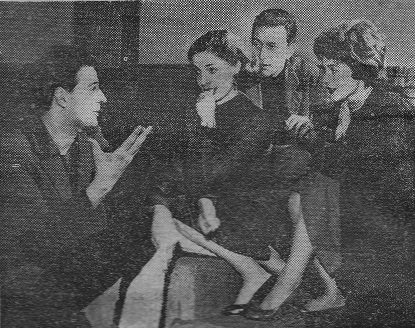
Above: From the Manchester Evening News: Contract director ‘Ted’ Kotcheff discusses a scene during rehearsals for ‘The Shining Hour’ with Peter, Elisabeth Sellars and Diana Fairfax.
Lise is violently resented by the older sister, Hannah (Marian Spencer) – a Cold Comfort Farm-type character, who flitters grimly about the place minding her brother’s business and making everybody else’s life a misery.
Soon after her arrival, Lise falls madly in love with her brother-in-law, David (Peter Wyngarde), who a particularly obnoxious son-of-the-soil. He, conversely, is already married to, Judy (Diana Fairfax) – a girl he no longer loves. Tragedy is hastened by Hannah), who informs Judy of her husband’s infidelity, which drives the attractive young woman to take her own life by walking into a burning barn.
Into this already troubled family comes another gentleman by the name of Micky (Clifford Elkin), who also gets the idea that it might be fun to pursue on of the brothers’ wives.
The most troubling part of this story concerns the character of David who, after taking his brother’s wife (in both senses of the word!), then changes his mind and decides not to elope with her!
A Bit Of Trivia
The play’s director, ‘Ted’ Kotcheff, was trained in the ‘Method’ school of acting. Peter also dabbled with ‘Method Acting’ in the mid-Fifties, but he described the discipline as merely “thinking oneself into the role”.
‘The Shining Hour’ was the third time that Peter and Elisabeth Sellars had worked together. They had planned to star in their own production of ‘Romeo and Juliet’ with the two in the leading roles.
‘The Shining Hour’ was first performed in London in 1934, with Gladys Cooper as Lise and Raymond Massey as David.
News Item
| THE HEARTTHROB He’s back again to-morrow girls….. The man 4,500 women wrote to after he appeared in a BBC serial, stars on ITV to-morrow. 24–year-old actor Peter Wyngarde is in ‘The Shining Hour”, the play that was cancelled a week ago because there were gremlins in the studio. He is fast becoming TV’s heart-throb on the drama side. He has seen in three plays during recent months. Peter’s 4,500 fans wrote to him when he took the lead in the serial, ‘A Tale of Two Cities’. To-morrow he co-stars with Elizabeth Sellars for the third time. This time they have a torrid screen romance in a farmhouse. They have a joint ambition – to play Romeo and Juliet together. Wyngarde is dark, sardonic, and single. His hobby: cooking. The Daily Sketch – Saturday, 4th January, 1958 |

 PETER WYNGARDE: The Official Website
One thought on “REVIEW: Armchair Theatre – ‘The Shining Hour’”