


The Hampstead Theatre Club. December 1967
Character: Felice
- N.B. The world premiere of the play was on Monday, 11th December, 1967.
“Your sister and you are insane!”
Some Background
This dark drama was written in the early 1960’s by American playwright, Tennessee Williams, and is believed to be semi-autobiographical, with the character of Felice being based, in part, on the author himself, and Clare – both as the ‘Actress’ and ‘Character’ – on his sister, Rose.
Although it took Williams more than a decade to write, when the play was first staged, it wasn’t particularly well-received by either critics or the paying public. It’s been suggested that, whilst audiences generally see the theatre as a diversion, Williams’ work in this instance, delivered precisely the opposite. The characters of Felice and Clare, together with the individuals who play them, are powerless to break away from their worsening psychological situation, regardless of their attempts to convince themselves otherwise. As a result, the audiences found themselves confronted by a far bleaker reality concerning the human condition that they’d bargained for.
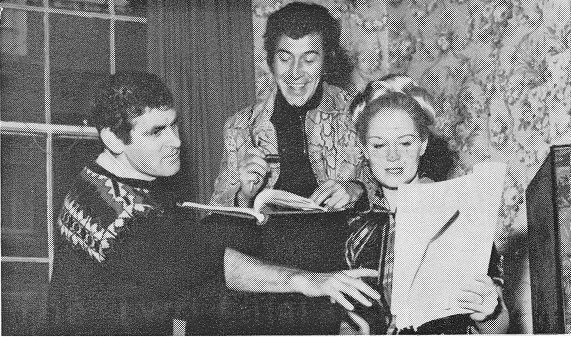
(Above): Peter and Mary Ure rehearsing the play with director James Roose-Evans
As with most of Williams’ plays, this particular composition is inhabited by broken personalities, entangled in their illusive pasts; caught within the confines of a partly-built theatre stage, representing a neglected wooden house.
By 1971, ‘The Two Character Play’ had been renamed ‘Out Cry’ – opening at the Ivanhoe Theatre in Chicago, and latterly transferring to Broadway at the Lyceum
The Story
The play tells the story of Felice (Peter Wyngarde) and Clare (Mary Ure) – a reclusive brother and sister. They are both actors on an American tour, when they’re ditched by their theatre company in what Tennessee Williams describes in the script as a dilapidated ‘State theatre in an unknown state”.
Although it shouldn’t come as a surprise to anyone who goes to see a production entitled ‘The Two Character Play’, Felice and Clare are the only two people in the work – and a very wordy piece it is too. It’s also immensely confusing, as this drama is, in fact, a-play-within-a-play.
Concerned that an audience, unaware that the main body of the troupe has left, might turn up at the theater expecting to see a performance, Felice sets about writing a play which he names ‘New Bethesda’. It’s set in a rundown house in a southern state of a America, where there’s no running water of electricity. The confusion begins when he chooses to name his two leading characters after himself and his sister, and to make the plot autobiographical. And so for most of the performance, it becomes increasingly difficult to distinguish between the two pairs of siblings: Felice and Clare ‘The Actors’ or Felice and Clare ‘The Characters’.
We learn early on that the siblings have been emotionally damaged after being witness to the catastrophic death of their parents (the father murdered their mother, and then turned a gun on himself). The two have remained reclusively in their family home ever since. By joining the theatre troupe they’re cautiously attempting to make contact with the world outside, but their interdependent relationship and deteriorating mental state has lead them to become more isolated than ever.
The two sets of siblings (‘Actors’ and ‘Characters’) are what might be described as opposite sides of the same coin. In the case of Felice, he’s at once the unstable thespian and yet, a fraction of a second later, becomes the thoughtful and perceptive resident of New Bethesda. And so whilst ‘The Two Character Play’ tops and tails between the pessimistic circus of the confined players and the misfortune of the orphaned brother and sister, the two grow increasingly disconcerted with each other. Indeed, whilst Felice develops a progressively demanding attitude with regard to how his sister should play ‘Clare’, she protests continually loudly and refuses point blankly to portray the character as he’s been written it.
Clare: I’ve lifted the receiver.
Felice: (Closing his eyes). Moment.
Clare: Felice, I said I’ve lifted the receiver.
Felice: Oh. Yes. Sorry. Who are you calling, Clare?
Clare: Not a
Felice: Soul still existing
Clare: In a world gone away.
Felice: Moment.
Clare: Are you lost in the play?
Felice: Yes. It’s a warm August day.
Clare: (Raising tender hand to his head). Felice, your hair’s grown so long. You really must find time somehow to get to the barber. We mustn’t neglect appearances even if we rarely go out of the house. We won’t stay in so much now. We’ll pull ourselves together and practice necessary deceptions so convincingly well that liables, commendable and essentials of persistence will be delivered to us again.
Felice: Go straight to the tall sunflower.
Clare: I’ve lifted the receiver.
Felice: (Closing his eyes). Moment.
Clare: Felice, I said I’ve lifted the receiver.
Felice: Oh. Yes. Sorry. Who are you calling, Clare?
Clare: Not a…
Felice: Soul still existing
Clare: In a world gone away.
Felice: Moment.
Clare: Are you lost in the play?
Felice: Yes. It’s a warm August day.
Clare: (Raising tender hand to his head). Felice, your hair’s grown so long. You really must find time somehow to get to the barber. We mustn’t neglect appearances even if we rarely go out of the house. We won’t stay in so much now. We’ll pull ourselves together and practice necessary deceptions so convincingly well that liables, commendable and essentials of persistence will be delivered to us again.
Felice: Go straight to the tall sunflower.
Clare: Quick as that?
Felice: That quick!
Clare: Felice, look out of the window, there’s a giant sunflower out there that’s grown as tall as the house. (He draws a long breath, then leans out the window).
Felice: Oh, yes, I see it. Its colours so brilliant that it seems to be shouting!
Clare: Keep your eyes on it a moment, it’s a sigh to be seen. (She raises a hand not quite to her eyes but toward them, as if to shield them from the blinding light. Then she turns to the sofa to lift the pillow: Draws a grasping breath).
Felice: Moment.
Clare: Moment.
(They continue saying ‘Moment’ to each other as the stage is slowly dimmed out).
END
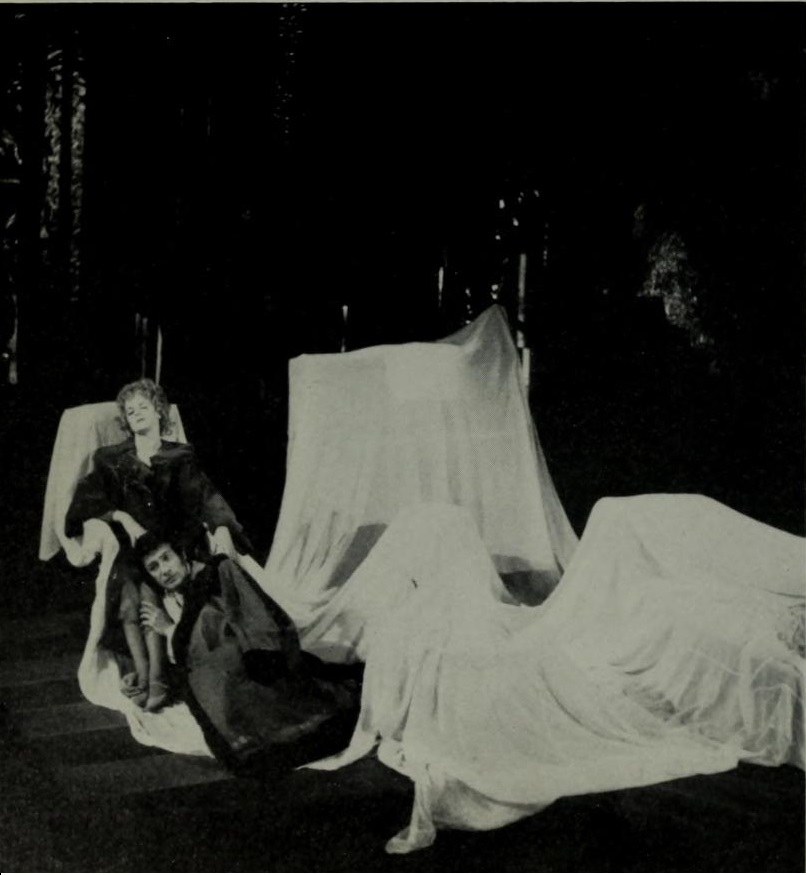
Above: Peter and Mary Ure on stage at The Hampstead Theatre Club
Peter’s View
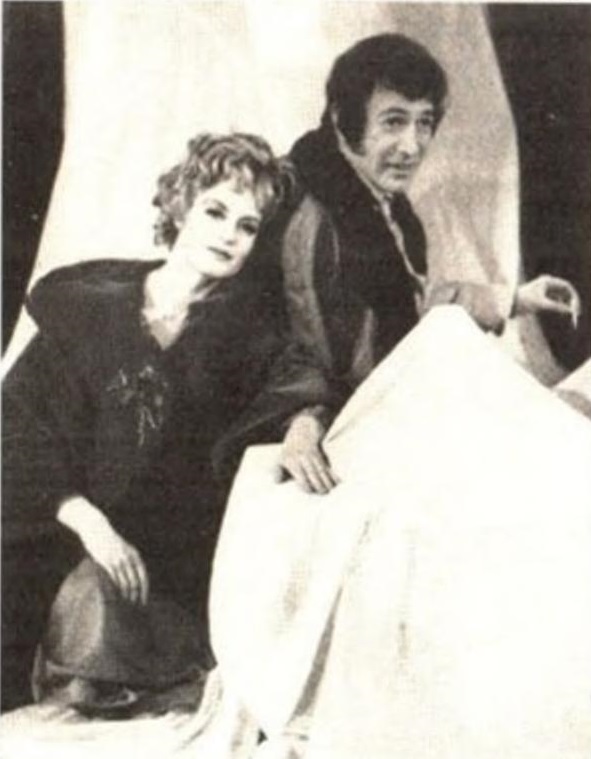
“It is the most harrowing part I have ever done. To convey the madness in the madness, like Chinese boxes, and yet to appear saner than Clare: we both came out after the show with hoops of steel around our heads. Because it is so near the bone, it’s a terribly depressing piece to play in which is unusual; ordinarily, one comes out of acting in a play, invigorated. And yet halfway through, it takes over. It is unquestionably a great piece, especially since the Out Cry[1] revisions. It is impossible to be bad in it… well, almost impossible.
“Tennessee was at all the rehearsals, with his wrenched companion of the time bullying him. But Tennessee was gone [drunk and stoned], out of it, completely. He could offer nothing approaching dictatorial advice.
“I never saw Tennessee and Maria together, although I met her separately. But I knew this: that she was a good influence on him at a terrible time. The death of his friend Frank Merlo had overwhelmed him.”
“I never saw Tennessee and Maria together, although I met her separately. But I knew this: that she was a good influence on him at a terrible time. The death of his friend Frank Merlo had overwhelmed him.”
| Notes: [1]: The revisions of The Two Character Play was called ‘Out Cry’ – of all Tennessee William’s plays, the only one he ever typed in capital letters. |

 PETER WYNGARDE: The Official Website
One thought on “REVIEW: The Two Character Play”