


Broadcast: Tuesday, 15th June 1954
Character: Lieutenant Fritz Lobheimer
The play is set in Vienna in 1900.
SCENE 1: Fritz’s apartment in an affluent district of Vienna.
SCENE 2: Christine’s room in the suburbs, next evening.
SCENE 3: The courtyard of an old house it the suburbs.
SCENE 4: A spinney on Prater Island, next morning.
SCENE 5: Christine’s room, three days later.
Some Background
There is no real translation for the German word, ‘Liebelei; the word doesn’t exist in any other language. It derives from ‘Liebe’, which means ‘Love’, and the suffix lei makes it something smaller. Therefore you could say it means ‘A little love’, in contrast to… ‘A great love’. But that doesn’t reduce its hidden meaning; it’s a melancholy, typically Viennese term of affection for a bitter-sweet, short-lived love affair.
The author, Arthur Schnitzler, was a doctor, playwright and novelist, who began writing in his spare time under the name ‘Anatol’.
Schnitzler once said that the femme fatal over whom a duel is fought in his story, but who never actually appears on screen, was based on a woman who’d once walked into his surgery in Austria.
The Story
This tale revolves around the character of Fritz Lobheimer (Peter Wyngarde) – a young gentleman of the upper classes and Lieutenant in the Imperial Dragoons. For some months, he’s been involved with Christine Weyring (Jeanette Sterk) – an attractive girl from the lower orders. The two have a number of mutual friends that include Theodore Kaiser (Derek Aylward), who’s also an officer in the Dragoons, and his current sweetheart, Mitzi Schlager – a milliner.
The story opens in the living room of Fritz’s apartment in a fashionable area of Vienna. The young Officer is regaling Theodore with stories of his affair with a married woman of his own class. Instead of being impressed by his philandering as Fritz had expected, Theodore advises his comrade that he’d be wiser to concentrate on his relationship with Christine who, like his own girlfriend, is both adoring and devoted: “Women are not to be interesting,” he urges, “but pleasant.”

Above: The cast and crew in Richmond Park, London, where some of the scenes for ‘Liebelei’ were shot. Peter can be seen seventh from the left in the back row.
Their exchange is interrupted by the arrival of both Christine and Mitzi, who Theodore has invited to enjoy an evening of drinking and dancing. The party, however, is disturbed by an insistent ringing of the doorbell. When Fritz finally goes to answer it, he finds an irate gentleman standing on the step. The Lieutenant immediately asks his friends to step into an adjoining room for a moment before allowing the caller inside.
It emerges that this ‘gentleman’ is none other than the husband of the woman with whom Fritz has been having the affair. He’s come to return a bundle of letters written by the young Officer to his wife, and before departing, he challenges the Lieutenant to a duel. Fritz can do nothing other than accept.
The following evening, as Christine is chatting with her well-intentioned neighbour, Katherine Binder (Joan Carol) outside her humble home in the suburbs of the city, the older woman informs her that there’s been a lot of talk in the area about her relationship with Fritz, and that she’d be better served by finding someone of her own class to marry and settle down. Christine, though, will hear none of it. She’s absolutely certain of her feelings for the dashing Lieutenant, and of his commitment to her. Certainly she can’t envisage loving anyone other than him.
Christine’s meddling friend, Mitzi, conspires to confound Mrs. Binder’s comments when she warns her about getting too close to Fritz. She appreciates that her own relationship with Theodore is just a bit of fun. Conversely, Christine’s father, Hans Weyring (Wilfred Lawson) defends his daughter and her choice of boyfriend – believing that she has a right to some happiness before settling down to a life of domestic monotony.
Soon after her encounter with Mrs. Binder, Fritz calls on Christine and sees her modest room for the first time. It’s clear by the pet-names he has for her (“Angel” and “Treasure”) that he’s fully appreciative of her adoration and earnestness. He confides in her that he’s had little experience of true love in his life, and that he feels comforted by the haven that she provides for him.
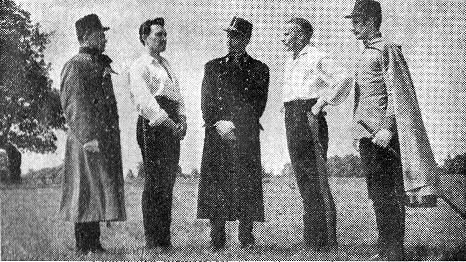
Above: ‘The Duel Scene’ – Peter is second from the left. From The Times, June 1954
This tender moment is shattered, however, on the arrival of Theodore, who asks to speak with Fritz privately. Once alone, he advises his friend to rest up so that he’ll be ready to fight in the duel which is scheduled for the following morning.
Two days later, Christine and Mitzi are together in the formers room. The two are deeply concerned that they’ve not heard from either of their men, in spite of their promising to be back by early afternoon after a trip to the country.
Ultimately, Theodore arrives alone to notify Christine that Fritz had been killed in the duel, and that he has already been buried. The young woman immediately breaks down – sobbing uncontrollably. Moments later, she rushes from the room – tears streaming down her face, as she goes to find her lover’s grave. But as her father predicts, she will never return home again.
Critics Comments
| “Arthur Schnitzler’s ‘Liebelei’ is a delightful Viennese romance and it was played so delicately that one might forget it was only a trifle. Peter Wyngarde’s Fritz was a dashing Lieutenant in the Imperial Dragoons who, too late, finds a love he believes will last. Jeanette Stark as Christine, the girl who gives all her love to Fritz, only to find despair in his death for another woman, played with tenderness and sincerely.” Plays and Players |

 PETER WYNGARDE: The Official Website
One thought on “REVIEW: Liebelei”