


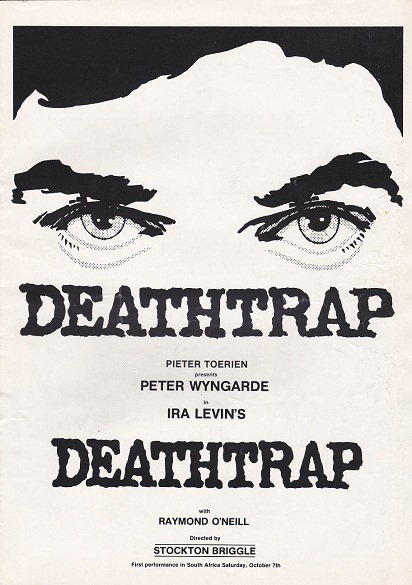
Presented by Pieter Toerien by arrangement with Bret Adams, African Tour – 1978
Character: Sidney Bruhl
The action takes place in Sidney Bruhl’s study in the Bruhl home in Westport, Connecticut
Act I
- Scene One: An afternoon in October
- Scene Two: That evening
- Scene Three: Two hours later
Act II
- Scene One: Two weeks later, morning
- Scene Two: A week later, night
- Scene Three: A week later, afternoon
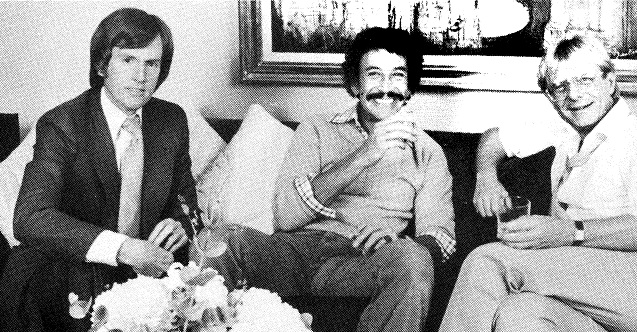
Above: Peter with producer, Pieter Toeien, and director, Stockton Briggle
Some Background
‘Deathtrap’ was written in 1978 by Ira Levin, and is a play within a play.
The comedy-drama was first performed in Boston in February, 1978, and thereafter moved to the Biltmore Theatre on Broadway. The production focused on here was one of the first stagings of Levin’s piece outside the United States.
In 1982, it was made into a film starring the late Christopher Reeve, Michael Caine and Dyan Cannon.
Alternating intrigue with humour, and throwing in more than one mind-reeling plot twist, Ira Levin’s ‘Deathtrap’ is a classic suspense thriller.
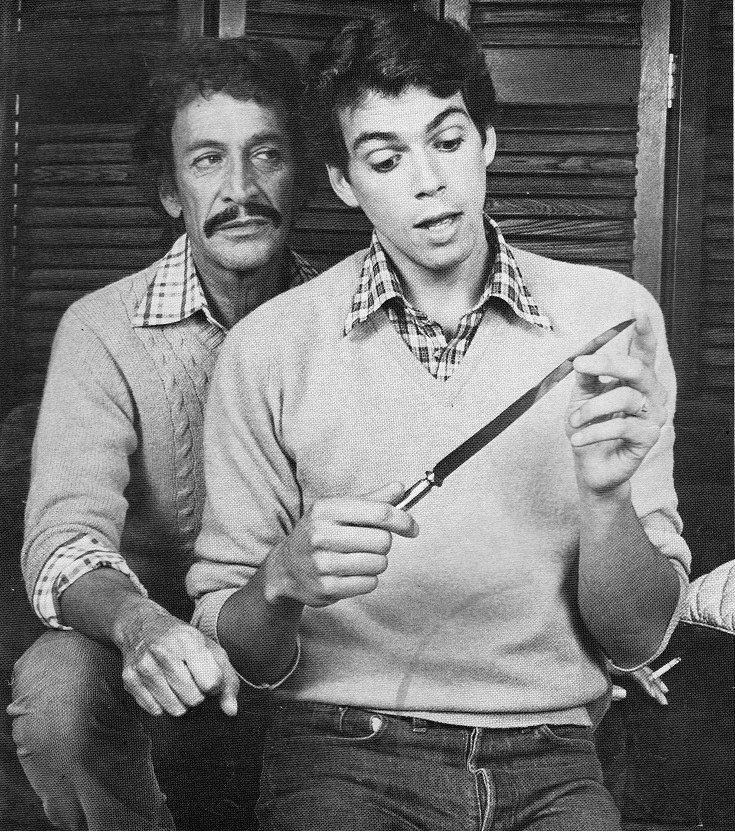
Below: Peter as Sidney Bruhl with Raymond O’Neill as Clifford Anderson
The play is both the epitome of the classic thriller, as well as a playful insider’s poke at the genre. “A thriller in two acts,” says Sidney of his protégé’s script at the opening curtain. “One set. Five characters. A juicy murder in Act One, unexpected developments in Act Two. Sound construction, good dialogue, laughs in the right places. Highly commercial.”
It’s an apt description of the play the audience is about to experience. Furthermore, as the narrative progresses, Levin continues to toy with references to his own play, within the context of Clifford’s script of the same name.
But Levin – nor Bruhl, for that matter! – invented the dramatic structure of the ideal thriller. Throughout the play, Levin cleverly alludes to the collection of other memorable thrillers to which Deathtrap belongs: Anthony Shaffer’s Sleuth, Dial “M” for Murder by Frederick Knott, Agatha Christie’s Witness for the Prosecution, and Angel Street by Patrick Hamilton, which Sidney credits with infecting him with thrilleritis malignis at the age of 15, the very same age at which Levin himself decided upon the career of a writer.
When multiple sets and many players mean mounting production costs, the advantages of a single set and limited cast are obvious. ‘Sleuth’, the play to which ‘Deathtrap’ is most often compared, took that theory to the extreme: Shaffer utilized a single set and only two actors to create one of the biggest hits of the 1970s, opening on Broadway in November 1970 and running for more than 1,100 performances. Its slim production costs, hardly at the expense of effective drama, are certainly one key to the show’s longevity. (Deathtrap, however, would beat Sleuth at its own game, running for nearly 1,800 shows later that decade).
The Story
Sidney Bruhl (Peter Wyngarde) is a celebrated writer of Broadway thrillers who’s suffering through a dry spell. After a string of embarrassing flops, he’s spending time in his comfortable Westport, Connecticut, home with his nervously afflicted wife, Myra (Beryl Gordon), hoping to be touched with inspiration along the lines of that which resulted in The Murder Game, Sidney’s magnum opus.
To make Sidney’s slump all the more painful, Clifford Anderson (Raymond O’Neill), a student of one of Sidney’s writing seminars, has recently sent his mentor a copy of his first attempt at playwriting for Sidney’s review and advice. The play, ‘Deathtrap’, is a five character, two act thriller so perfect in its construction that, as Sidney says, “A gifted director couldn’t even hurt it.”
Using his penchant for plot, and out of his desperate desire to once again be the toast of Broadway, Sidney, along with Myra, cook up an almost unthinkable scheme: They’ll lure the would-be playwright to the Bruhl home, kill him, and market the sure-fire script as Sidney’s own.
But shortly after Clifford arrives, it’s clear that things are not what they seem. Indeed, even Helga Ten Dorp (Patricia Sanders), a nosey psychic from next door, admits that her visions appear correct only in part. When the mystic leaves, Sidney calms his wife by pointing out that only a fraction of what had been revealed was actually correct, and that the clairvoyant had not precisely recounted the murder of Clifford at all. It’s only then that Myra admits her own closet hope that Sidney would go through with his plan to kill the young writer and take his script.
On that note, the two get ready for bed when suddenly Clifford – who is covered from head to toe in mud, grabs Sidney from behind and beats him to death. Completely traumatized by what she’s just witness, Myra collapses and dies from heart-failure. Once Clifford has checked to ensure that the woman is indeed deceased, he announces to Sidney that their “plan” has been successful; the young man’s murder had clearly been staged to free Burhl from his wife.
Two weeks later, and Clifford has moved into the Burhl’s home. Sidney, meanwhile, is still struggling with writers block when his attorney, Porter Milgrim (Robin Dolton) tells him that he’d witnessed Clifford locking a manuscript he’s been working on into his desk drawer. Immediately, Sidney goes to the drawer where he discovers that Clifford has been working on a piece entitled ‘Deathtrap’, which is unmistakably based on the plot to instigate Myra’s death.
When he returns home, Sidney challenges Clifford, who exclaims that he will simply move out and continue working on the play should the older man continue to object. Reluctantly Sidney resolves to help write the play.

A short time later, Helga returns to the house to warn Sidney that Clifford is planning to harm him, so the playwright tells his lodger that he’s managed to finish the second act of the play, but needs to run it by him to make sure it’s convincing. Little does the young man know, but Sidney has contrived a plan to stop him writing about Myra’s slaying: by acting out the sections he’s completed, he hopes to kill Clifford and make it look as if he was merely defending himself.
Clifford, however, has anticipated this move, and has replaced the bullets in Sidney’s revolver with blanks. Unwittingly, Sidney has given his former accomplice the ending he needed for his play.
He now compels Sidney to handcuff himself to a chair. The ‘cuffs, though, are replicas and Sidney is soon able to make his escape, whereupon he mortally wounds Clifford with a crossbow. Convinced that Clifford is dead, Sidney telephones the police, but as he does so the young man clambers to his feet behind the playwright, and wrenching the arrow from his own body, he plunges it into Sidney. Both men drop to the ground, dead.
A week later, Helga contacts Porter Milgrim, and tells him what actually occurred at the Bruhl house through her visions.
The two instantly recognise what a first-rate story it would make if brought to the stage. But neither can agree over the finer points, and each of them begin to quarrel and intimidate the other over what financial gains might come from the play.

 PETER WYNGARDE: The Official Website
2 thoughts on “REVIEW: Deathtrap”