


British Tour – Presented by HM Tennant Ltd. and LOP Ltd.
British Tour 1958/59
Opened: Apollo Theatre, London, April 24, 1958
Character: Count Marcellus
US tour – presented by Roger L. Stevens and S. Hurok
Opened: Helen Hayes Theatre, New York, April 19, 1960.
American Tour 1960 (selected theatres): Alcazar Theatre, San Francisco – Blackstone Theatre, Chicago – Blackstone Theatre, Chicago – Helen Hayes Theatre, Broadway, New York – National Theatre, Washington D.C. – Shubert Theatre, New Haven, Connecticut
Character: Count Marcellus
Cast (UK)
Joseph – Derek Nimmo
Marcellus – Peter Wyngarde
Gilly – Fiona Duncan
Paola – Vivien Leigh
Armand – Basil Hoskins
Lucile – Claire Bloom
Eugenie – Pauline Jameson
Barbette – Freda Jackson
Marcellus Servant – Brian Harrison
Justice Blanchard – Robin Bailey
Cast (USA)
Joseph – James Valentine
Marcellus – Peter Wyngarde
Gilly – Aina Niemela
Paola – Vivien Leigh
Armand – John Merivale
Lucile – Mary Ure
Eugenie – Ludi Claire
Barbette – Margaret Braidwood
Marcellus Servant – Ken Edward Ruta
Justice Blanchard – Alan MacNaughtan
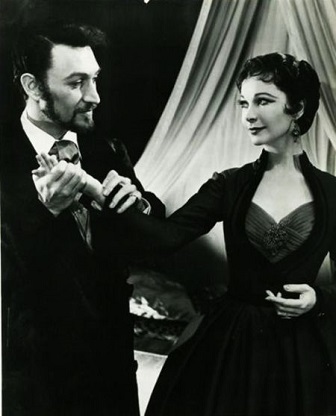
Above: Peter as Count Marcellus and Vivien Leigh as Paola
Act I
- The Terrace of the café
Act II
- A room at Marcellus’ house
Act III
- Mr. Justice Blachard’s study
“There is nothing more impressive as a good horseman climbing the stairs” Poala about Count Marcellus
Some Background
‘Duel of Angels’ by Jean Giraudoux, was another theatrical skirmish between the sexes that seemed so popular throughout the late Fifties and Sixties. On this occasion, however, it lined up firmly on the side of woman, and pours destructive barrages of scorn of the disparaging moral standards of men.
Giraudoux was clearly fascinated by the legend of the lady, Lucretia, whose reputation for integrity was a hot topic in ancient Rome. However, when she was coerced into adultery by the tempestuous Sextus, she revealed her wrongdoing to her husband the following morning, and then ended her own life. Giraudoux asks in his play why she did it, and was it really worth it?
The Story
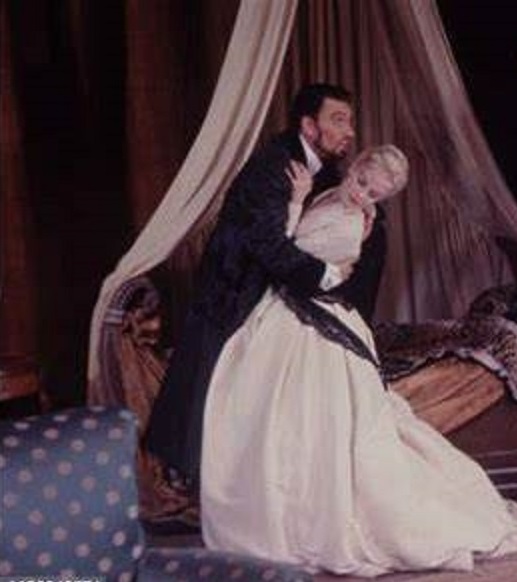
The action of ‘Duel of Angels’ is moved from the Eternal City to the small French town of Aix-en- Provence in 1968, where the authors Lucretia is represented by Lucile (Claire Bloom/Mary Ure) [1], the prim wife of Justice Blanchard (Robin Bailey/Alan MacNaughtan) [2] – a straitlaced reforming judge, who has vowed to rid the town of vice.
Right: Peter as Marcellus, with Mary Ure as Lucile.
So determined is Lucile not to compromise her moral code, that she will not so much as communicate with anyone who she believes to be guilty of unfaithfulness.
“Try asking her for sugar”, one of the townsfolk announces, “and if you’ve just been reading the Decameron she won’t touch it!”
Particularly disturbed by this woman’s aggressive virtue is Poala (Vivien Leigh) – a married woman who has slept with all but a handful of men in the town. In complete opposition the Lucile, she believes that all women should be united in their collusion to deceive men.
Matters take a turn when Lucile is motivated to telling Paola’s husband of her cheating, and so she must take her revenge. Whilst the Judge’s wife sits sipping ice water on the terrace of a café, Poala hatches her plan

To this end she decides to drugs Lucile and has her taken to the bedroom of the handsome Count Marcellus (Peter Wyngarde) – a man with a certain reputation in the town. Believing that the Count has raped her, Lucile’s desperation leads her to demand that her husband must restore her honour. However, when he finds that his wife has dishonoured him – even under the influence of drugs, has a most unsympathetic attitude – regarding her as hopelessly tainted. However, before Blanchard can exact revenge on Marcellus, the Count falls fowl to bullet fired by Armand [3] – Poala’s jealous husband.
The resulting altercation leaves the Count dead and Lucile’s husband a fugitive, but this is not the worst of it. Only after Marcellus death does she learn that he had never so much as laid a finger on her. Lucile now realises that Paola was right all along; it’s men that use the innocence of their wives only to reinforce their own self-esteem.
Disillusioned by her husband, and finding only finding immorality around her, she takes poison in order to claim her final victory of virtue over deceit and degradation.
Barbette [4] is left with the difficult speech in which the author shifts the ultimate blame on to the stupidity and grossness of men.
| Notes: [1]. Lucile was played by Claire Bloom during the British tour, and Mary Ure during the US leg. [2]. Justice Blachard was played by Robin Bailey throughout the British tour, and by Alan MacNaughtan during the US leg. [3]. Armand was played by Basil Hoskins during the British tour, and by John Merivale during the US leg. [4]. Barbette was played by Freda Jackson during the British tour, and Margaret Braidwood during the US leg. |
“Vice has a mission to perform today, and no man alive is going to make him relinquish it!” Count Marcellus.
In Retrospect
Jean Giraudoux, whose play was translated from French into English by Christopher Fry, was apparently willing to allow the spotlessness represented by Lucille to show, not only an aspect of cruelty, but also an aspect of silliness. In the second act, her conviction that her chasteness has been sullied leads to the conviction that she must be the wife of the man who had violated her. It becomes, in her view, the duty of him then to then kill himself.
Marcellus, Poala’s former lover, is confronted by her husband, Armand. The two men are obliged to fight a duel. “As soon as I opened my window I could see that today is a day of reckoning,” Armand tells him. “The sky is clear blue and an invisible line cuts sheer across it; you can tell at once it’s a judgement sky”
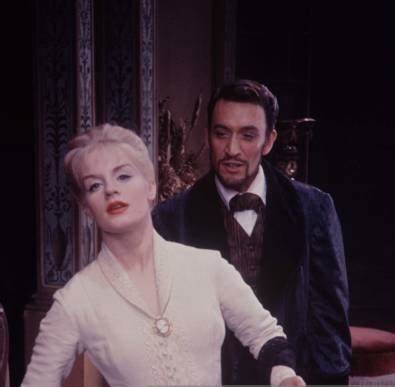
The manner in which she tries to wash out the stain by bringing about the death of Marcellus rises to a point of melodramatic excitement, but the third act brings the audience back to earth when it realises that there was really no motive behind this survival of the enduring virtue. Ironically, it’s only after Marcellus’ death that she herself is driven to suicide – not from shame, but from the exposure of the deception.
The woman who would rather die than acknowledge evil may have been beaten in the duel, but only her vanquisher knew the bitterness that often eats at the victorious. Lucile, dressed from head to toe in white, expressed the fall of the gentle being, whose sense of purity the world had outraged, most admirably. Paola meanwhile – attired in all crimson, let the world’s shame discreetly appear in the acceptance of her rival’s death.
Giraudoux’s play was as unsparing as it was brilliantly theatrical. It was a melodrama, as Paola put it, which was played out by a set of characters who didn’t realise they were in a farce.

Caricatures from (left) The Daily Telegraph: Lucile and Paola, watched by Count Marcellus and, (right), the Count in The Tatler – both 1958.
Critics Comments
| “Centre stands Count Marcellus, played by Peter Wyngarde, looking like the devil at court. He proudly proclaims that the local magistrate has branded him with the title Vive Incarnate.” The Oxford Mail “The contrasting characters of both woman are convincingly portrayed, but among the male characters the only one that really comes to life is the villain, splendidly played by Peter Wyngarde”. The Liverpool Echo “Unlike the Roman Lurece Lucile is not raped at all. but is assured she has been; and the culprit is named as Marcellus, whom Peter Wyngarde makes as virile as he is Mephistophelean” Liverpool Daily Post “There are fine performances, from Peter Wyngarde as Marcellus, the rubato of whose walk up to Lucile when she accuses him of being too cowardly to fight a duel touched perfection.” The Scotsman “Peter Wyngarde plays the rake with a superbly raffish air.” Kemsley Evening Chronicle “Peter Wyngarde, as Marcellus, was admirable. Nothing rang false in his character.” Journal and North Mail “The leading male role was forcefully taken quite in the note of the Paris theatre, by Peter Wyngarde (Don Juan with a swagger!).”Scottish Daily Express “The men give fine support. As Marcellus , the rake, Peter Wyngarde combines swagger and strength.” The Evening Chronicle “Since both actresses loyally refuse to play for sympathy, the one character that engages our affections is Count Marcellus, the rake, which is partly why the acting of Peter Wyngarde seems so much the best thing of the evening.” The Manchester Evening News “Peter Wyngarde cuts a cynical, bright figure as Count Marcellus, flamboyant libertine who unwittingly becomes Miss Leigh’s accomplice in deluding Mary Ure as Lucile. He has a distinctive stage voice, reminiscent of Jose Ferrer.” The Times – July 18th, 1958 “Mr. Wyngarde’srake has the period aura about him, and an enormous charm. If his death were not a charade it would seem a fearful waste.” The Evening Standard – July 18th, 1958 “Peter Wyngarde is handsome and adept in a finely-delivered performance as Count Marcellus…” The News Herald & Journalist – July 17th, 1958. “Marcellus, the supposed seducer; was admirably played by Peter Wyngarde who gave just the right impression of an outwardly, careless Don Juan with hidden reserves of strength.” The Guardian – July 17th, 1958. “The stage is bright when Peter Wyngarde, the male counterpart of evil is working. He is a virtuoso actor with a mesmerizing sixth sense for timing.” The Chicago Herald – September 13th, 1960 |
Special Awards
While playing Count Marcellus in Duel of Angels on Broadway, Peter won a Tony Award for being ‘The Most Promising Newcomer’.
He also picked up another award that same year – The ‘San Francisco Award for Best Actor in a Foreign Play’ – again for his portrayal of Count Marcellus.
A Bit Of Trivia
The play which, in the original French was entitled ‘Pour Lucrece’, was originally to be called’ Vice With Virtue’.
All the ladies costumes in the play were designed and made by Christian Dior.
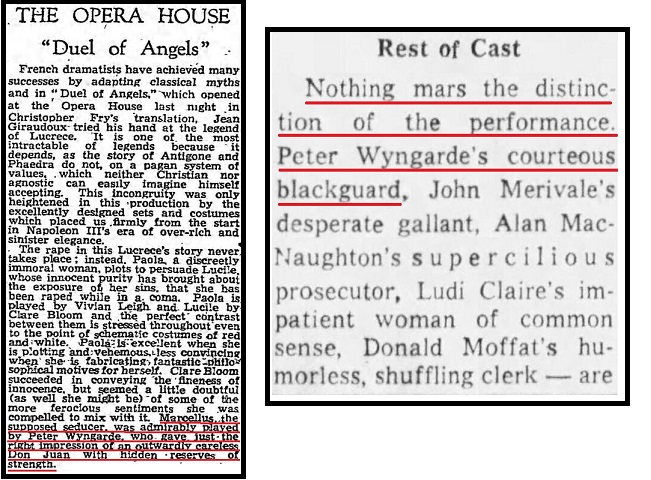
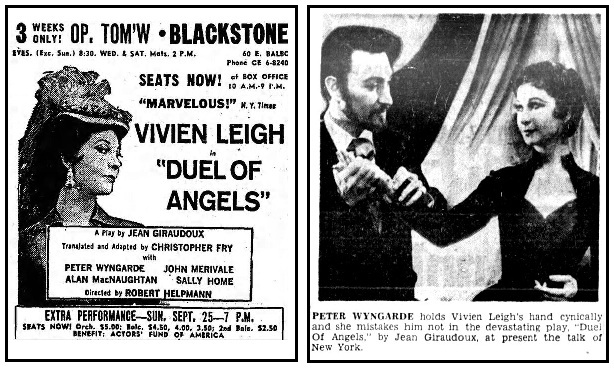
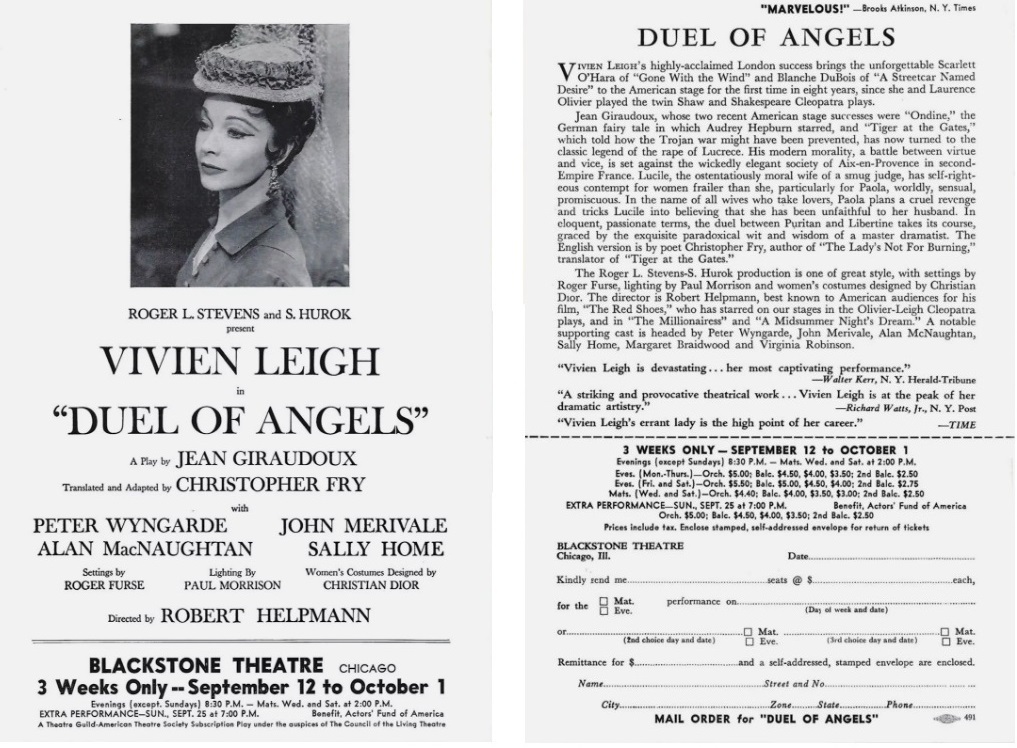
Below: Playbills from the US Tour



Left: Programme from the Helen Hayes Theatre on Broadway, 1960, with ticket stub
Also see…

 PETER WYNGARDE: The Official Website
7 thoughts on “REVIEW: Duel of Angels”